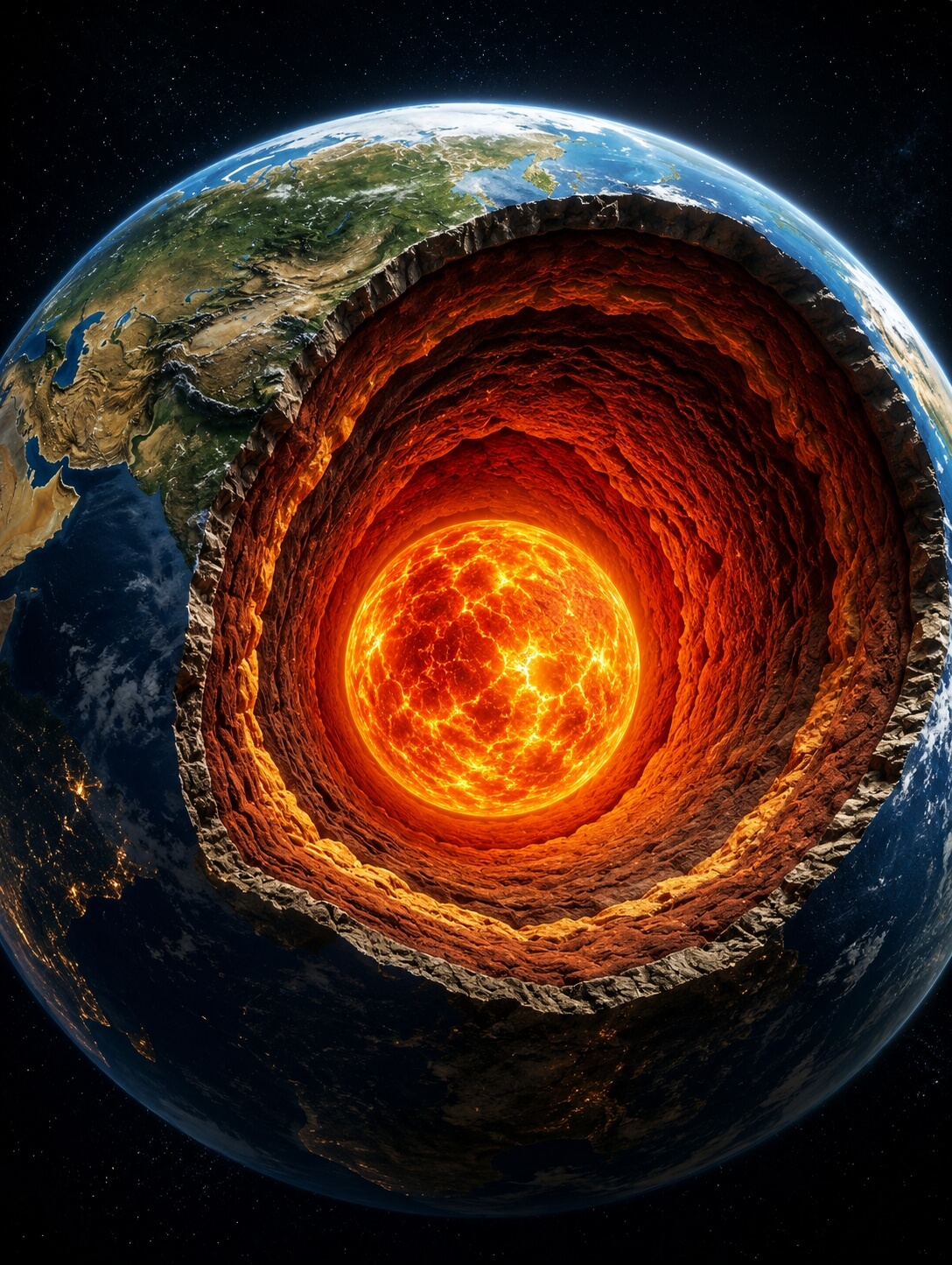
In the 1970s, the Soviet Union began drilling the Kola Superdeep Borehole, which ultimately reached a staggering depth of 12,262 meters (about 12.2 kilometers). It remains not only the deepest "telescope" ever pointed into the Earth in human history, but also a mysterious site shrouded in both groundbreaking science and wild urban legends.
Setting aside the viral internet myths about a "well to hell" or "hearing the screams of the damned," scientists did indeed make three major discoveries during the excavation that completely turned the scientific consensus and textbooks of the time on their head:
1. The Missing "Granite-Basalt" Transition Zone (Conrad Discontinuity)
Before the drilling began, geology textbooks worldwide accepted a standard theory: the Earth's crust was divided into two distinct layers—a lighter upper layer of granite and a heavier lower layer of basalt. Based on seismic wave data, scientists predicted that at a depth between 3,000 and 6,000 meters, the drill would cross a boundary (known as the Conrad Discontinuity) and transition into hard basalt.
The Mind-Bending Truth: When the drill bit passed this depth—and even when it surpassed 10,000 meters—there was absolutely no basalt to be found.
What Was Actually There: The rock at that depth was still granite. The shift in seismic waves wasn't caused by a change in rock type at all, but rather by metamorphism triggered by intense heat and pressure. This fractured the internal structure of the granite and left it saturated with water, directly forcing scientists to rewrite their theoretical models of the Earth's crust.
2. A Surprising Abundance of Water at Enormous Depths
According to traditional geological theory, under the ultra-high pressure and extreme temperatures found 10,000 meters underground, the Earth's crust should have been bone-dry, tightly compressed, and incapable of holding water. Any moisture was expected to have been squeezed out, evaporated, or unable to penetrate to such depths in the first place.
The Mind-Bending Truth: As the drill plunged kilometers into the earth, eventually passing the 10,000-meter mark, scientists discovered massive amounts of liquid water.
Where Did the Water Come From? Water was weeping right out of the local calcite and other minerals. This wasn't "rainwater" that had seeped down from the surface; instead, the crushing pressure underground had literally "squeezed" hydrogen and oxygen atoms out of the rock minerals. This formed a brand-new, deep-crust water layer trapped by the immense pressure, proving that Earth's internal water cycle is vastly more complex than previously imagined.
3. Signs of Life from 2.0 Billion Years Ago (Microfossils)
At a depth of around 6,000 meters, within ancient sedimentary rock formations dating back 2.0 billion years, scientists stumbled upon a staggering biological discovery.
The Mind-Bending Truth: Scientists discovered 24 distinct species of ancient microscopic fossils (primarily single-celled microfossils like acritarchs) preserved within these deep core samples.
Why It Overturned Assumptions: Traditional consensus dictated that it was impossible for intact biological remnants to survive in rock layers this ancient, which had been subjected to eons of geological heat and pressure. Yet, these fossils were remarkably well-preserved, shielded by thick protective casings of organic carbon and nitrogen that kept them intact through billions of years of tectonic activity. This not only rewrote the timeline of life's resilience on Earth but also offered entirely new angles for the search for extraterrestrial life.
Keep exploring
When you want adjacent angles on Earth, the theme hub rounds up sibling articles in the same editorial voice. The full archive helps you compare how topics evolve as new missions and surveys release data.