"Earth is just floating peacefully in space." That entire premise is dead wrong. Earth isn't floating at all. In fact, it is in a state of violent, chaotic freefall—and it has been crashing through the cosmos for 4.5 billion years without pausing for a single millisecond. Think of our planet as an extreme skydiver, hurtling through the vacuum of space at a breakneck speed of 100,000 kilometers per hour. But here is the kicker: it will never, ever hit the ground.
To truly wrap your head around this terrifyingly beautiful reality, we have to look at the two most famous thought experiments in the history of physics:
Why Is It Considered a "Fall"? (Newton's Cannonball)
Over 300 years ago, Sir Isaac Newton fired a cannon inside his own mind. He imagined placing a massive cannon atop a mountain peak and firing a cannonball horizontally into the horizon. If you use just a little gunpowder, the cannonball flies a short distance and crashes back to Earth. If you pack in more gunpowder, it blasts much farther, but the relentless tug of Earth's gravity eventually pulls it down to the ground.
The Mind-Bending Twist: What happens if you load it with an overwhelming amount of gunpowder, launching the cannonball at a critical velocity? (On Earth, this threshold is the First Cosmic Velocity, roughly 7.9 km/s). At this point, the cannonball is still technically falling toward the center of the Earth every single second. However, the downward curve of its plunge now perfectly matches the natural curvature of the Earth's surface. As the cannonball violently falls, the ground beneath it literally curves away at the exact same rate. The cannonball is trapped in an eternal state of falling, yet because it is moving so incredibly fast, it keeps missing the ground.
This is the exact reality of Earth. The only reason our planet doesn't obliterate itself by slamming directly into the Sun is because it possesses a massive horizontal orbital speed of 29.78 km/s (nearly 100,000 km/h). The Sun's gravity is constantly pulling Earth downward into a perpetual plunge, but because we are sprinting sideways so fast, the distance we fall each second is perfectly offset by the distance we hurdle forward. In modern science, this state of "falling forever but never hitting the bottom" has a much more familiar name: weightlessness, or freefall.
Why Has It Been Falling for 4.5 Billion Years Without Hitting Bottom? (Einstein's Trampoline)
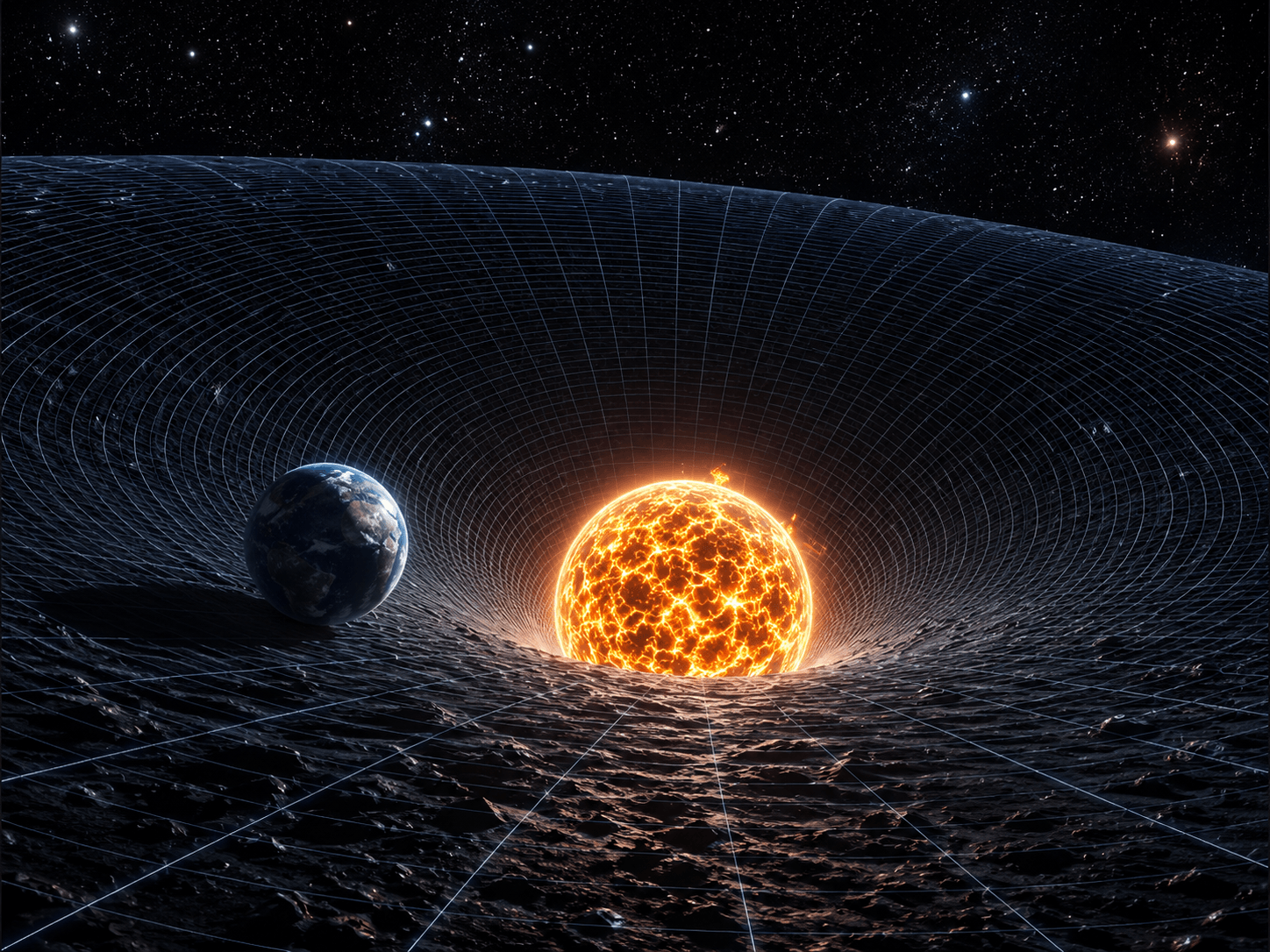
While Newton used "gravity" to explain the fall, Albert Einstein used his theory of General Relativity to pull back the curtain on the true nature of space itself. Einstein shattered the old consensus by stating that there is no such thing as a mysterious, invisible "pull" called gravity. Instead, gravity is merely the geometric manifestation of warped spacetime. Picture the Sun as a colossal, ultra-heavy bowling ball placed on a giant trampoline. It deforms the otherwise flat fabric of cosmic spacetime, carving out a massive, steep valley—a gravity well. Earth is like a tiny marble thrown into this cosmic funnel.
Earth is wildly rolling down the slope of this deep valley. If our planet were stationary, it would plunge into the heart of the Sun and burn to ash in a heartbeat. Fortunately, Earth was born with an immense sideways momentum. It storms across the slope at full throttle, meaning it is forced to spiral around the rim of the funnel, circling the "bottom" (the Sun) over and over again. Because space is a near-perfect vacuum, there is no air resistance to slam the brakes on Earth's momentum. With no friction to bleed off its kinetic energy, Earth has spent the last 4.5 billion years endlessly plunging down this solar valley without ever slowing down.
The Ultimate Cosmic Sprint: Falling Deeper into the Abyss
If that doesn't trigger a sense of cosmic vertigo, brace yourself: Earth isn't just falling toward the Sun.
The Sun is dragging the entire solar system along as it falls toward the supermassive black hole at the center of the Milky Way at a staggering speed of 220 kilometers per second.
The Milky Way and our entire Local Group of galaxies are being ruthlessly yanked by a terrifying gravitational anomaly deep in the cosmos known as The Great Attractor, falling toward it at hundreds of kilometers per second.
When you look at it this way, describing the universe as an "11-stage universal cloaking maze" makes perfect sense. In this labyrinth, Earth is never still, and it is never truly "floating." We are all just passengers trapped on a cosmic roller coaster, screaming through the dark abyss of spacetime at hundreds of thousands of miles per hour—hurtling into the void for 4.5 billion years, and we aren't stopping anytime soon.
Keep exploring
When you want adjacent angles on Earth, the theme hub rounds up sibling articles in the same editorial voice. The full archive helps you compare how topics evolve as new missions and surveys release data.