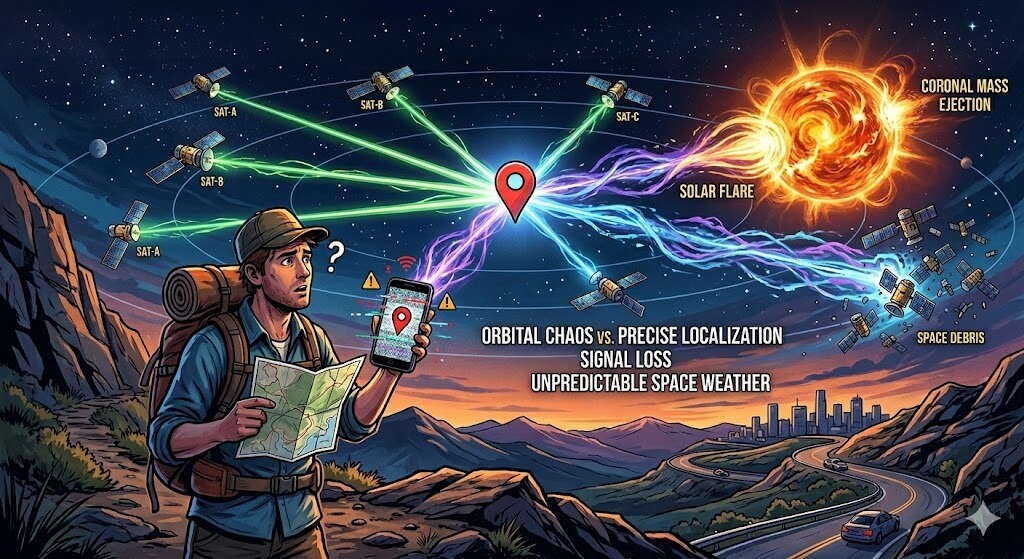
The essence of any navigation system (like GPS or BeiDou) comes down to calculating the exact time delay it takes for a signal to travel between a satellite and your phone. Since light travels incredibly fast, a microscopic error of just one microsecond (a millionth of a second) translates into a 300-meter positioning error on the ground.
If Earth's rotation slows down while the atomic clocks on the satellites keep ticking at their original pace, a subtle drift occurs between the satellites and Earth's surface coordinates. To prevent autonomous cars from driving into ditches, missiles from missing their targets, and airplanes from misaligning with runways, scientists must constantly and meticulously recalibrate the orbital parameters of global satellite systems.
The "Love-Hate Relationship" Between Earth's Rotation and GPS: Fascinating Trivia
When you strip away the cold, hard equations, the relationship between Earth's slowing rotation and GPS navigation is packed with mind-blowing trivia. Here are some of the most incredible facts:
In the Age of Dinosaurs, GPS Wouldn't Even Need "Leap Seconds"
Earth's slowing rotation isn't a recent phenomenon; it's a 4-billion-year-long game of cosmic braking. The culprit slamming on Earth's brakes is the Moon. The Moon's gravitational pull creates ocean tides. As these massive bodies of water slosh across the planet and rub against the ocean floor, they act like a giant brake pad, slowing Earth down by about 2.3 milliseconds per century.
Back in the Jurassic period, when dinosaurs ruled the planet, Earth spun much faster—a day lasted only about 23 hours. If dinosaur pilots had used GPS back then, their satellite clock calibration logic would have been entirely different. At this rate, hundreds of millions of years from now, a day on Earth could stretch to 25 or 26 hours. (Look on the bright side: that just means future generations will have to endure longer workdays!)
Earth Doesn't Just Slow Down—It "Dances" and "Shakes"
While the long-term trend is a slowdown, Earth is actually a bit of a restless, chaotic spinner. Its rotational speed frequently fluctuates, throwing unexpected curveballs at scientists:
Earthquakes make the planet spin faster: In 2011, the massive 9.0-magnitude earthquake in Japan caused tectonic plates to shift violently, concentrating Earth's mass slightly closer to its core. Much like a figure skater pulling in their arms to spin faster, this sudden shift shortened the length of that day by 1.8 microseconds!
Winds and ocean currents interfere, too: Annual El Niño events, melting glaciers from global warming, and even massive seasonal storms act like "invisible hands" pushing or pulling the planet. This causes microscopic, daily stutters in Earth's rotation. Scientists have to babysit these tiny wobbles around the clock, instantly feeding the correction data into the GPS almanac and ephemeris.
GPS Satellites Logistically Live in the "Future"
Beyond the "ground factor" of Earth's erratic rotation, navigation systems must also grapple with the ultimate boss of physics: Albert Einstein's Theory of Relativity. Without constant calibration, relativity would warp the time difference between satellites and the ground in a bizarre way:
Special Relativity states: Because satellites travel at blistering speeds (about 14,000 km/h), time moves slower for them. This causes the satellite clocks to lose 7 microseconds a day relative to Earth.
General Relativity states: Because satellites orbit 20,000 kilometers above us, gravity is much weaker up there. The weaker the gravity, the faster time passes. This causes the satellite clocks to gain 45 microseconds a day.
The Net Result: Combined, the atomic clocks on satellites run 38 microseconds faster every day than clocks on Earth! While 38 microseconds sounds like the blink of an eye, leaving it uncalibrated would cause GPS positioning errors to accumulate by 11 kilometers every single day. Within 24 hours, your navigation system would be routing you into the ocean. To fix this, scientists intentionally program the atomic clocks to run slightly slower before launching them into space, ensuring they tick in perfect harmony with Earth.
Bracing for 2029: The World's First-Ever "Negative Leap Second"
Because Earth has historically been slowing down, we have traditionally added one second to our clocks every few years to let the Earth catch up (we've done this 27 times since 1972). This is known as a leap second. However, in a bizarre twist of events, Earth has actually been speeding up recently. This is driven by mysterious shifts in the liquid metal flow of Earth's core, combined with the redistribution of mass as polar ice caps melt.
Scientists now predict that around 2029, global clocks will need to subtract one second to stay aligned with Earth's faster rotation. This means a single second will completely vanish, and clocks will skip directly from 23:59:58 to 00:00:00.
This is called a "negative leap second," and it has never happened in human history. Tech companies and software engineers are scrambling to prepare. While the infamous "Y2K bug" was just about changing a year, a negative leap second means time is missing or skipping backward. Many legacy server codes have no idea how to handle a missing second, which could trigger widespread glitches across global computer networks.
So, the next time you pull out your phone to hail a ride or check your food delivery status, remember: it isn't just a simple connection. Behind that precise blue dot on your screen is a relentless symphony of atomic clocks, deep-space telescopes, tectonic shifts, lunar tides, melting glaciers, and moving magma all working together to keep the world on track.
Keep exploring
When you want adjacent angles on Earth, the theme hub rounds up sibling articles in the same editorial voice. The full archive helps you compare how topics evolve as new missions and surveys release data.