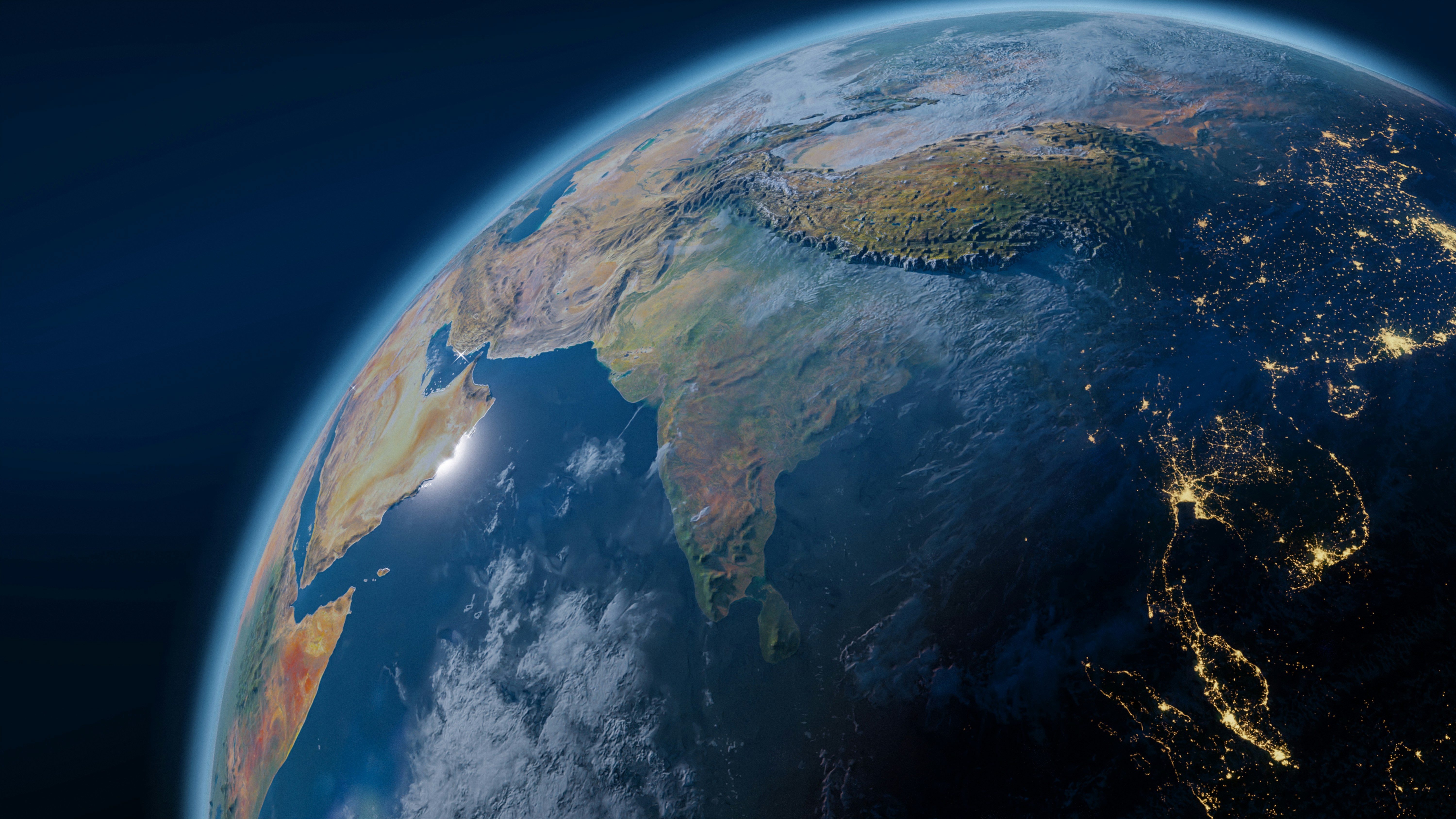
We tend to think of Earth as a sealed cosmic vault. In reality, it is constantly "exhaling" into the universe while "inhaling" space dust.
Every single day, about 90 tons of light gases—predominantly hydrogen and helium—escape from the top of our atmosphere into the abyss of outer space. At the same time, tens of tons of dust and cosmic debris rain down on Earth. When you balance the cosmic ledger, Earth suffers a net loss of about 40,000 to 50,000 tons of mass every year. While this weight is a mere drop in the bucket for a planet as massive as ours, it means Earth is, quite literally, getting lighter by the day.
Within our lifetimes—and even before the Sun meets its demise—this weight loss will have zero perceptible impact on us. However, if we stretch our timeline to a cosmic scale, or if we indulge in a wild thought experiment where Earth's weight loss "fast-forwards" aggressively, things get incredibly fascinating.
Losing 40,000 to 50,000 tons a year sounds staggering (equivalent to tens of thousands of cars), but compared to Earth's total mass, it is practically rounding error.
Let's do some quick math: at a rate of 50,000 tons lost per year, it would take Earth roughly 120 trillion years to completely "leak" into nothingness. Meanwhile, our Sun is projected to age and die in just about 5 billion years. This means that by the time Earth reaches the end of its natural lifespan, it will have lost less than 0.01% of its total mass.
Consequently, in the real world:
Gravity will not weaken: You won't feel yourself getting lighter over time, nor will you suddenly start jumping higher.
Our orbit will not shift: Earth won't lose its grip and drift away into deep space; it will remain locked securely in its current orbit around the Sun.
The Real Crisis: Leaking the "Cradle of Life"
While the change in total weight is negligible, the types of matter Earth is losing are what actually keep scientists up at night. Earth is primarily bleeding hydrogen and helium. Hydrogen, as we know, is the crucial building block of water (H2O). Every day, a silent breakdown occurs in the upper atmosphere: solar ultraviolet rays split water molecules into hydrogen and oxygen. The featherlight hydrogen gas escapes into space, leaving the heavier oxygen behind to bind with materials on the surface.
If this process were to accelerate indefinitely, Earth's true existential crisis wouldn't be "fading away," but "drying up." Our next-door neighbor, Mars, is a sobering cautionary tale. Due to its smaller mass and weak magnetic field, Mars had its atmosphere violently stripped away by solar winds over billions of years. Its surface water vanished into the void, transforming it into the barren, red desert we see today.
In reality, Earth's "leakage-driven weight loss" is just the old planet's normal cosmic metabolism, and it is perfectly safe. The real threat we should be sweating isn't the planet getting lighter, but rather our own destruction of its ecosystems. After all, while it takes the universe hundreds of millions of years to evaporate a few thousand tons of Earth's water, it only takes humanity a few days to ruin an entire freshwater source.
Keep exploring
When you want adjacent angles on Earth, the theme hub rounds up sibling articles in the same editorial voice. The full archive helps you compare how topics evolve as new missions and surveys release data.