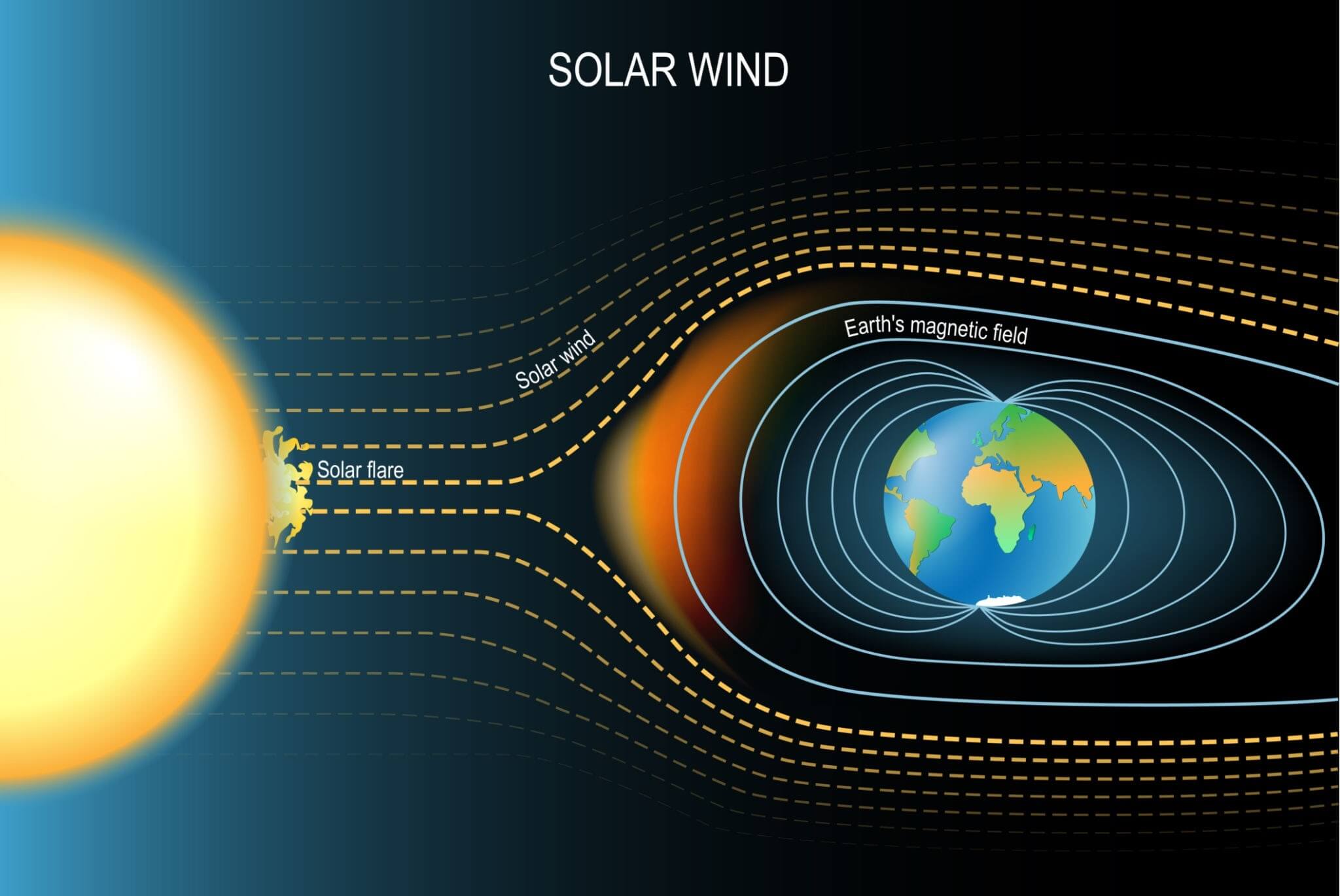
We are used to the comforting certainty of a compass needle always pointing north. In reality, however, Earth's magnetic field is a bit of a cosmic gymnast. Throughout our planet's history, the North and South magnetic poles have swapped places hundreds of times. What was once the North Pole becomes the South Pole, and vice versa.
Earth's last major magnetic reversal occurred roughly 780,000 years ago. Scientists have noted that over the past 160 years, the strength of Earth's magnetic field has been steadily depleting—a telltale sign that another planetary flip-flop might be right around the corner.
What Actually Happens During a Flip? During the transition, the geomagnetic field plummets to a fraction of its normal strength or becomes completely fragmented. This allows cosmic rays to bombard the atmosphere directly, threatening to paralyze global navigation systems, crash power grids, and ignite surreal, planet-wide aurora light shows.
Chronology of the Last Reversal: The Matuyama-Brunhes Event
That last flip, which took place 780,000 years ago, is known to science as the Matuyama-Brunhes reversal. When people hear the phrase "magnetic reversal," they immediately envision Hollywood-style apocalyptic doomsday scenarios: a cracking Earth, mass extinctions, and our evolutionary ancestors being incinerated by cosmic radiation. But the geological and fossil records reveal a shocking truth: when the poles flipped last time, almost nothing catastrophic happened. Instead of a sudden apocalypse, Earth experienced a prolonged, strange, yet remarkably peaceful "geomagnetic labor pain."
No Doomsday: Life Carried On Unfazed
Scientists examining the fossil layers from 780,000 years ago found that:
There were no mass extinctions: From woolly mammoths and saber-toothed cats on land to microscopic plankton in the oceans, there is zero evidence of a sudden die-off.
Our ancestors thrived: Our direct ancestors, Homo erectus (such as Peking Man and Heidelberg Man), were successfully hunting and using fire. Throughout the millennia of the transition, they didn't just survive; they actually underwent critical evolutionary leaps toward more advanced human species.
A Glacial Shift, Not a Flick of a Switch
Many people assume that a magnetic flip is instantaneous—like throwing a light switch, causing compasses to snap southward in a split second. In truth, it is an incredibly slow, chronic process. Deep-sea sediment cores and volcanic rock samples indicate that the Matuyama-Brunhes reversal took anywhere from 4,000 to 9,000 years to complete. It unfolded in three distinct phases:
The Weakening Phase: For thousands of years, the magnetic field didn't just pull a U-turn; instead, it steadily degraded until it was at roughly 10% of its normal strength.
The Chaotic Phase: With the primary field severely weakened, the distinct "North and South" poles vanished altogether. Earth's surface was simultaneously dotted with multiple, weak, chaotic magnetic poles. If you held a compass back then, the needle would either spin erratically or point in wildly different directions depending on your geographic location.
The Realignment Phase: After millennia of chaos, the magnetic lines finally began to coalesce, strengthen, and safely lock into place—albeit upside down.
Prehistoric Spectacles: Auroras and Cosmic Radiation
While it didn't trigger apocalyptic earthquakes or volcanic eruptions, the weakening of our planetary shield for thousands of years did produce some genuinely otherworldly phenomena:
Global Aurora Shows: Normally, Earth's magnetic field funnels the solar wind (charged particles) toward the poles, which is why auroras are a high-latitude exclusive. But during the chaotic transition phase, solar storms smashed directly into the entire planet. The night skies above the equator likely shimmered with vibrant, dancing auroras normally reserved for the Arctic Circle.
Radiation Surges (Blocked by a Secondary Shield): Without a strong magnetic field, cosmic rays and solar radiation penetrated much deeper into the atmosphere. Fortunately, Earth possessed a second line of defense: its thick atmosphere. This heavy blanket of air successfully shielded surface life from the most lethal, short-wave cosmic radiation. The fossil record indicates that while organisms experienced minor genetic mutations (which may have actually fast-tracked evolution), they were not wiped out by radiation.
Disorientation in the Animal Kingdom: Animals that rely on magnetoreception for long-distance migration—such as pigeons, sea turtles, and whales—faced a thousands-of-years-long crisis. The chaotic magnetic field stripped away their internal navigation systems, leading to spikes in mass strandings and lost migrations. However, because the process spanned millennia, many species managed to adapt by leaning heavily on alternative navigation cues, like starlight, coastlines, and scent.
The Modern Dilemma: What If the Poles Flipped Today?
Given that 780,000 years have passed since the last reversal (well beyond the historical average interval between flips), and considering our magnetic field is actively weakening, a reversal may indeed be brewing. Nature and wildlife would almost certainly adapt and survive just as they did before. However, for modern human civilization, it would be an entirely different story. We have built something our ancestors never dreamed of: an intricate, delicate, global technological infrastructure entirely dependent on electromagnetism.
If Earth's magnetic field drops to 10% capacity today, the consequences would be severe:
The Satellite Graveyard: Stripped of magnetic shielding, intense solar flares would permanently fry the electronics of our orbital infrastructure—including GPS, weather, and telecommunication satellites.
Global Grid Collapse: Solar storms slamming into the upper atmosphere would induce massive, uncontrollable currents in electrical grids on the ground. This would trigger cascading, planet-wide blackouts and explode heavy transformers, potentially plunging humanity back into a pre-electric dark age for months or years.
A Run on Sunscreen: With solar ultraviolet radiation and cosmic rays intensifying at ground level, skin cancer rates would spike significantly. Venturing outdoors would require full-body protective gear.
The Takeaway
Seven hundred and eighty thousand years ago, the magnetic reversal was merely a long, quiet administrative transition for Mother Nature. If it happened today, however, it would be a devastating, high-tech reality check for human civilization.
Keep exploring
When you want adjacent angles on Earth, the theme hub rounds up sibling articles in the same editorial voice. The full archive helps you compare how topics evolve as new missions and surveys release data.