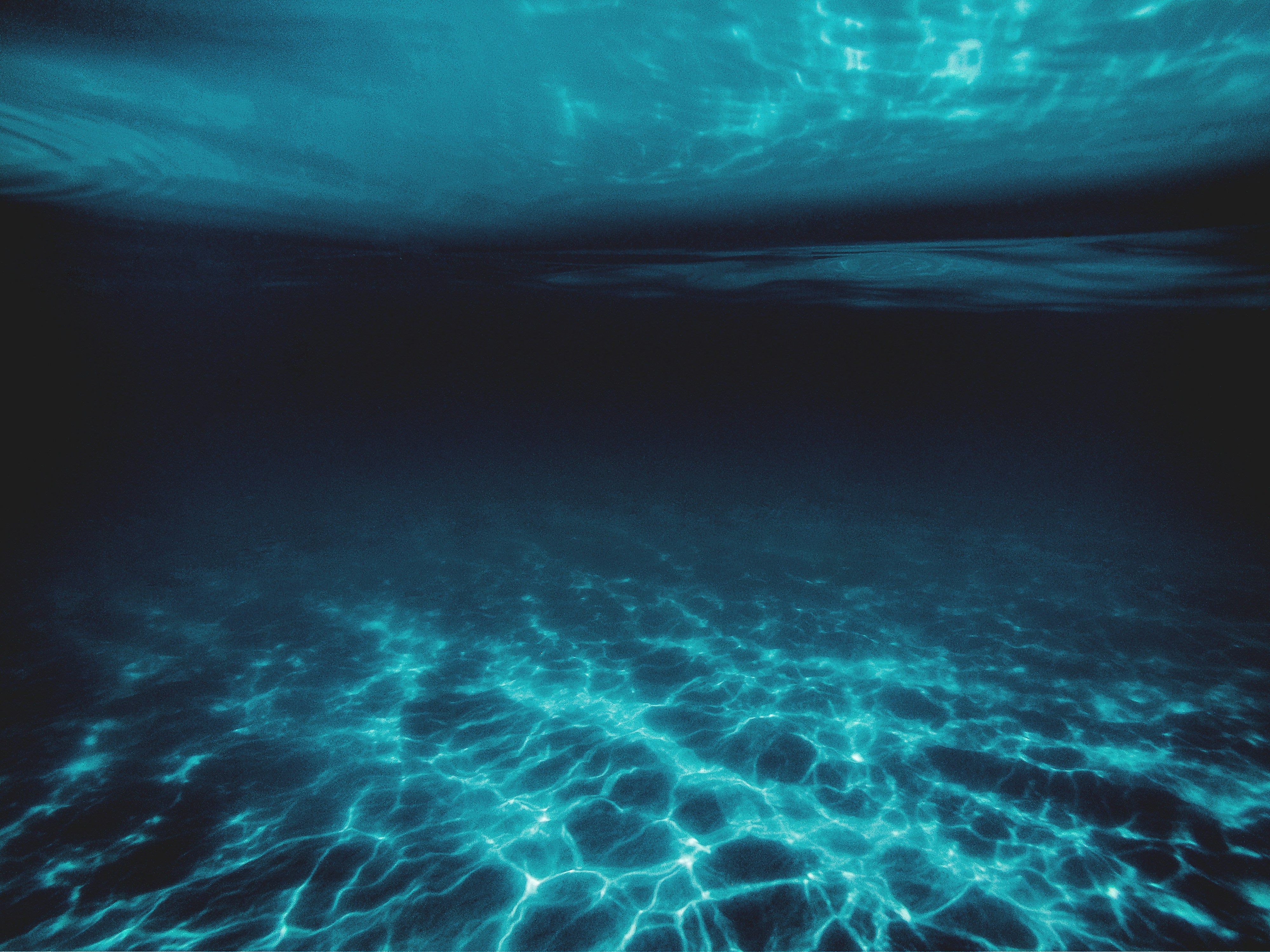
Textbooks always teach us that 71% of Earth's surface is covered by oceans. However, scientists have uncovered a staggering secret deep within our planet: a second "Pacific Ocean" might be locked beneath our feet.
At a depth of about 410 to 660 kilometers (250 to 400 miles) below the surface—a region known as the mantle transition zone—lies an incredibly rare, blue mineral. This mineral acts like a high-pressure sponge, trapping massive amounts of water molecules within its crystalline structure. Scientists estimate that the water stored here could be one to three times the volume of all surface oceans combined!
The Mind-Bending Twist: It isn't a vast, hollow "underground cavern" of sloshing liquid water like you might picture. Instead, the water is dissolved at a molecular level, trapped inside solid rock. The water on our surface today was likely "squeezed" out of these rocks over billions of years through volcanic eruptions.
Where Did Earth's Water Come From?
For decades, the scientific community has been locked in a fierce debate over the origin of Earth's oceans, divided into two primary camps:
The Out-of-This-World Hypothesis: This theory suggests that the young Earth was a bone-dry ball of rock. Later, water was "delivered" by a relentless bombardment of icy comets and asteroids.
The Homegrown Hypothesis: This theory posits that water was trapped inside Earth from the very beginning—essentially, the planet "birthed" its own oceans.
The discovery of this deep "underground ocean" provides ironclad evidence for the Homegrown Hypothesis.
It proves that 4.5 billion years ago, when Earth was forming, the primordial dust and rocks already locked away vast reservoirs of water. As the planet's interior subjected these rocks to intense heat and pressure, the trapped water molecules were slowly squeezed out. They escaped to the surface as water vapor via volcanic activity, condensed into torrential rains, and eventually pooled to form our oceans.
The Deep Earth Water Cycle: Water Moves Beneath Our Feet
In geography class, we all learned the basic "water cycle": seawater evaporates into clouds, clouds rain onto the land, and rivers carry it back to the sea. But the discovery of the deep mantle ocean reveals that scientists had missed a massive "underground pipeline" in this loop.
Swallowing Water (Subduction Zones): As oceanic plates plunge and slide into the mantle due to tectonic movements, they drag massive amounts of seawater and hydrated minerals down into the deep interior.
Spewing Water (Mantle Plumes and Volcanoes): Deep within the mantle, this water is processed under extreme heat and pressure, locking into minerals like ringwoodite. When volcanoes erupt or mid-ocean ridges tear open, this water is "breathed" back to the surface as vapor.
Without this deep-mantle loop, Earth's surface water might have long been stripped away by solar winds and cosmic radiation. The "ocean" inside Earth and the oceans on the surface have been locked in a multi-billion-year cosmic tug-of-war, maintaining a perfect, dynamic equilibrium.
The Planet's Natural Lubricant for Earthquakes and Volcanoes
You might wonder: Why should we care if there is water locked in rocks hundreds of kilometers below us? It matters immensely—because it directly dictates whether the ground we walk on remains stable.
A "Softener" for Rocks: When water molecules enter mantle minerals, they dramatically lower the melting point of the rock, making hard rock pliable and fluid—a property scientists call "plasticity."
Driving Plate Tectonics: Without this water in the mantle, Earth's interior would be as rigid and stiff as dry sand, causing tectonic plate movement to completely seize up. If the plates couldn't move, the crust wouldn't be able to release its internal pressure incrementally. Eventually, the built-up thermal energy would cause the entire planet to fracture in catastrophic, world-ending earthquakes and super-volcanic eruptions.
A New Road map for Finding Alien Life
If the deep rocks of Earth can harbor such staggering amounts of water, what does that mean for other seemingly "barren" planets in the universe?
In the past, scientists hunting for extraterrestrial life only focused on worlds with visible liquid water on their surfaces (like ancient Mars). But Earth's secret teaches us a vital lesson: a piece of clothing might look dry on the surface, but if you wring it out, it can be soaking wet.
Mars and the Moon: Their surfaces are currently desolate deserts, but do their cores and mantles harbor vast, hidden oceans of ringwoodite just like Earth?
Icy Worlds: Frozen moons like Jupiter's Europa and Saturn's Enceladus are famous for their subsurface liquid oceans. However, deep beneath those ocean floors, their rocky mantles might also contain the ultimate, high-pressure cradles for the genesis of life.
Keep exploring
When you want adjacent angles on Earth, the theme hub rounds up sibling articles in the same editorial voice. The full archive helps you compare how topics evolve as new missions and surveys release data.