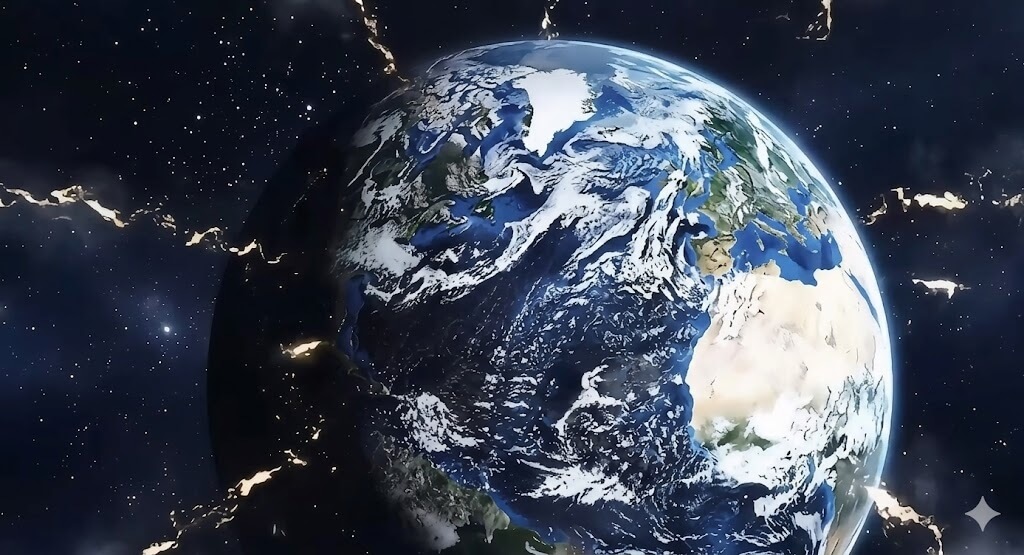
If you could stand in the vacuum of space and look down at Earth on a crisp morning 2.2 billion years ago, you wouldn't see the vibrant blue marble we call home today. Instead, you would behold a blindingly white, hopelessly desolate, massive snowball.
An ice sheet up to 1,000 meters thick clad the planet like heavy iron armor, pinning the Pacific and Atlantic oceans deep beneath a frozen crust. Surface temperatures hovered around a perpetual -50 degree. There was no sound of wind, no crash of waves—only a deathly, absolute silence. This apocalyptic cataclysm, which completely formatted the planet and held it in a frozen chokehold for 300 million years, is known to science as the Huronian Glaciation. Yet, the most chilling twist of this catastrophe is its culprit. It wasn't a rogue asteroid from deep space, nor was it a world-ending volcanic eruption. It was an invisible serial killer lurking inside each of us today—the very oxygen you breathe this morning.
Before oxygen transformed into the mastermind behind this cosmic murder mystery, the primordial Earth was actually a thriving sanctuary for gentle, ancient microbes. The atmosphere back then held virtually no oxygen; instead, it was thick with toxic carbon dioxide and methane. Even though the young Sun was 20% to 30% dimmer than it is today—which logically should have turned Earth into an absolute icebox—the planet remained remarkably warm. Why? Because methane is a hyper-potent greenhouse gas, possessing over 20 times the heat-trapping capability of carbon dioxide. This dense blanket of methane wrapped the planet like a heavy, plush winter coat, sealing in Earth's core body temperature. Beneath this warmth, in emerald-green oceans, countless anaerobic bacteria drifted happily, viewing oxygen as a lethal poison.
Then, at the dark bottom of the sea, a microscopic organism named Cyanobacteria (commonly known as blue-green algae) came into being. These primitive cells had no idea they were about to unlock a biological cheat code that would defy the existing cosmic order: photosynthesis. They began greedily devouring carbon dioxide, and as a mere metabolic waste product, they exhaled Earth's very first breath of oxygen. As the cyanobacteria multiplied at an uncontrollable, apocalyptic rate throughout our ancestral oceans, they unleashed the most devastating wave of environmental pollution in planetary history: the Great Oxidation Event.
To the anaerobic bacteria that ruled the world, oxygen was a violent oxidizing agent—it was pure arsenic. As oxygen saturated the oceans, boundless populations of ancient microbes choked and died en masse, their carcasses carpeting the seafloor. Having decimated its neighbors, the rampant oxygen tore upward into the sky. There, it collided with the very architect of Earth's warmth: methane. Under the ruthless laws of chemistry, oxygen and methane engaged in a catastrophic war of attrition, violently reacting to convert the ultra-insulating methane into carbon dioxide and water.
It was a total structural demolition. In a mere flash of cosmic time, oxygen ripped away Earth's heavy winter coat, leaving the planet shivering in a tattered, threadbare vest. Stripped of its methane shield, Earth's temperature went into a terrifying freefall. The true nightmare began as polar glaciers advanced rapidly toward the equator. As the pristine, blinding ice and snow carpeted the surface, they turned the planet into a giant mirror, ruthlessly bouncing the meager incoming sunlight back into the vacuum of space.
This triggered physics' most merciless trap—a positive feedback loop: the colder it got, the more glaciers grew; the more glaciers grew, the more sunlight they deflected; and the more sunlight deflected, the colder the planet became. Finally, around 2.2 billion years ago, the advancing northern and southern ice caps collided at the equator. The entire planet froze to death, locked away as a dead snowball. A mile of ice sealed the oceans. The daylight striking the frozen surface reflected with a cold, blinding glare. There was not a single drop of liquid water on the surface; not a single sign of life remained. In this disaster orchestrated entirely by oxygen, Earth died a desperate death. And it would remain frozen for a staggering 300 million years.
In those 300 million years of dark, frozen suffocation, how on earth did life survive? Beneath 1,000 meters of solid ice, down in the pitch-black, freezing abyssal depths of the ocean floor, the survivors—persecuted by oxygen and besieged by ice—were forced to retreat to the absolute last line of defense: hydrothermal vents, the deep-sea "black smokers." Here, cradled by the last faint whispers of heat radiating from Earth's molten core, and surrounded by lethal sulfides, our ancestors endured. In that toxic darkness, they clung to existence for three million centuries, waiting for a miracle that seemed mathematically impossible.
Ultimately, it wasn't life that saved the planet, but Earth itself. The volcanoes erupted.
A thousand meters of ice could choke the surface, but it could not hold back the raging fury of the mantle. Countless super-volcanoes tore through the icy crust, violently spewing gargantuan amounts of carbon dioxide into the atmosphere. Because the planet's biosphere was paralyzed, there were no plants and no rainfall to scrub the carbon dioxide from the air. The greenhouse gas accumulated at an exponential, unchecked rate. After 300 million years, the trapped carbon dioxide triggered a runaway greenhouse effect of biblical proportions. In the span of a single geological epoch, the ice sheets violently collapsed and melted away. Earth woke up, drenched and gasping for air.
When those 300 million years of ice finally retreated and sunlight once again kissed the warm, open seas, a completely reshuffled, sanitized world was born. Those survivors who had starved and struggled around the deep-sea vents emerged into an oxygenated world, fundamentally transformed. Because of this brutal, high-pressure system reboot, eukaryotic organisms—armed with highly efficient, oxygen-processing mitochondria—completely took over.
In the eons that followed, they evolved into multicellular organisms, into plants, into dinosaurs, into mammals, and ultimately, into you, sitting here reading this grand history. And that is the most mind-bending, ironic truth of our cosmos: every single breath of oxygen you take to stay alive this very second was once the apocalyptic poison that nearly wiped life off the face of the Earth 2.2 billion years ago. And you are the direct descendant of those grand, ultimate prisoners who stared down 300 million years of frozen darkness beneath a mile of ice—and won.
Keep exploring
When you want adjacent angles on Earth, the theme hub rounds up sibling articles in the same editorial voice. The full archive helps you compare how topics evolve as new missions and surveys release data.