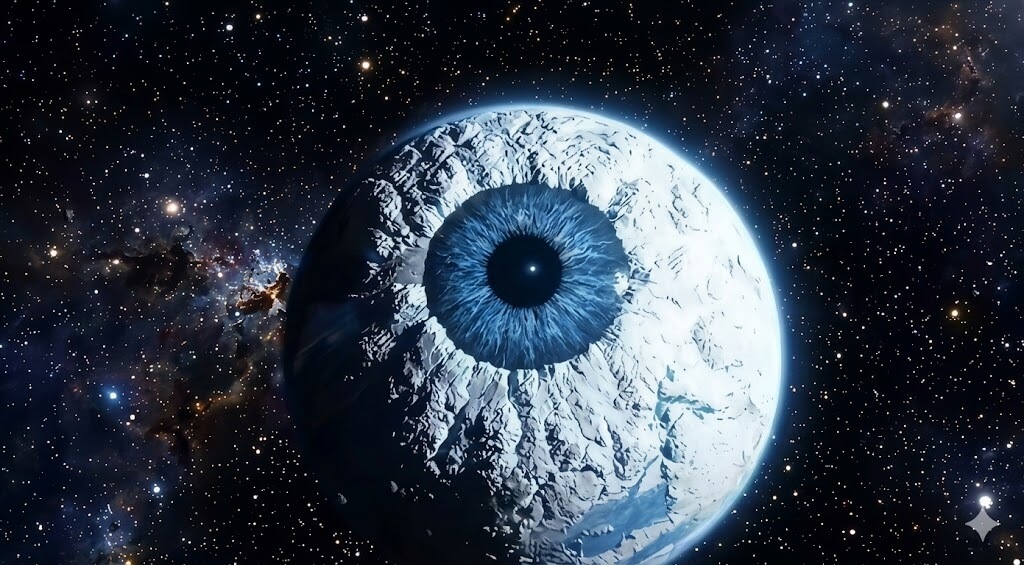
Deep in the structural vastness of the cosmos, 48 light-years away in the constellation Cetus, floats a super-Earth cataloged as LHS 1140 b. Seen from the icy silence of deep space, this planet resembles a colossal, unblinking eye staring motionlessly into the endless void. This is the cosmic wonder that has recently upended our understanding of oceans—a colossal water world.
To comprehend the origin of this "cosmic eye," one must look to the eternal gaze between the planet and its host star. Orbiting perilously close to its "sun," LHS 1140 b was long ago captured by powerful gravitational forces and became tidally locked. Much like the Moon keeps a solitary face toward Earth, this planet presents only one side to its star. In this world, there is no alternation of day and night, no cycle of seasons. The nightside is a realm of perpetual darkness and absolute cold, shrouded in a planetary ice sheet that makes it resemble a stark, lifeless snowball suspended in space.
Yet, a miracle unfolds on the side bathed in eternal day.
On this face of permanent daylight, the relentless warmth of the star acts like a brush on canvas, melting a flawless, circular expanse out of the boundless white glaciers. There lies an open ocean shimmering with a deep, spectral blue, spanning an astonishing 4,000 kilometers in diameter. From orbit, the surrounding ice sheets form the eyelids, while the circular sea forms the pupil. It lays exposed amidst the glacial wastes—completely motionless, never blinking—an eternal gaze fixed upon the cosmos.
When we speak of Earth's oceans, the sheer majesty of the Pacific seems to define the limits of our imagination. Yet compared to LHS 1140 b, Earth's water supply looks like a mere film of moisture clinging to the surface of a freshly washed tennis ball; water accounts for a meager 0.05% of our planet's total mass. By contrast, this world 48 light-years away is a true cosmic reservoir. Several times the mass of Earth, up to 10 to 20 percent of its entire weight is composed of water. The "bull's-eye ocean" visible on the surface covers an area equivalent to half the Atlantic, while beneath that thick glacial crust and open sea lies a subterranean ocean plunging tens or even hundreds of kilometers deep. Its total volume dwarfs all of Earth's oceans combined by dozens, if not hundreds of times.
Could a planet with such immense water reserves and surreal geography truly be a cradle for life? Armed with faint signals of captured starlight, scientists have begun piecing together a rigorous case for its habitability.
In assessing a planet's potential for life, water is merely the first threshold; the far more brutal test lies within its atmosphere. Previously, astronomers worried that because LHS 1140 b closely hugs a red dwarf, the star's volatile flares and radiation would strip the planet's atmosphere away like layers of an onion, leaving its oceans to boil off into the vacuum. Fortunately, this particular star has proven remarkably quiet. Even more promising are the latest spectroscopic insights from the James Webb Space Telescope, which suggest the planet is not choked by a suffocating envelope of hydrogen like Neptune, but instead likely harbors a thick, nitrogen-dominated atmosphere reminiscent of Earth's own.
The presence of this atmosphere provides a vital shield. A substantial atmospheric layer would function as a planetary climate control system. Through fierce global winds and deep currents, it would continually distribute the intense heat captured by the "cosmic eye" toward the freezing dark side. This atmospheric circulation keeps the dayside ocean from evaporating into a desert while preventing the nightside air from freezing solid.
Under this scientific model, the 4,000-kilometer-wide open ocean, churning under the dim red star, becomes an ideal primordial crucible. Along the oceanic margins where glaciers meet open water, a dynamic melting zone churns with a cocktail of elements not unlike early Earth's prebiotic soup. Here, protected by a stable atmosphere and blessed with stable temperatures and liquid water, life would not need to hide in the pitch-black depths of a subglacial ocean. Organisms could bask directly in the rays of a sun that never sets, driving a unique form of photosynthesis tailored to this twilight world.
Though separated by a gulf of 48 light-years, LHS 1140 b acts as a dramatic mirror to Earth, showcasing an entirely different template for habitability. If life on Earth was born across a temperate, dynamic global ocean beneath white clouds and blue skies, LHS 1140 b demonstrates a stark alternative: even on a world locked in permanent day and night, life can still find a way to stir beneath the unblinking watch of a giant cosmic eye, provided the vital thread of an atmosphere remains unbroken.
Today, this immense eye sits quietly in its habitable orbit, utterly still. Far away on Earth, scientists guide humanity's most advanced space telescopes to stare back across the void. It has become a sublime dialogue between two worlds—humanity peering into that deep, unblinking blue eye, searching for the faint chemical breath of alien life, wondering if a soul yearning for the stars is waking up in the depths of that ancient, alien sea.
Keep exploring
When you want adjacent angles on Earth, the theme hub rounds up sibling articles in the same editorial voice. The full archive helps you compare how topics evolve as new missions and surveys release data.