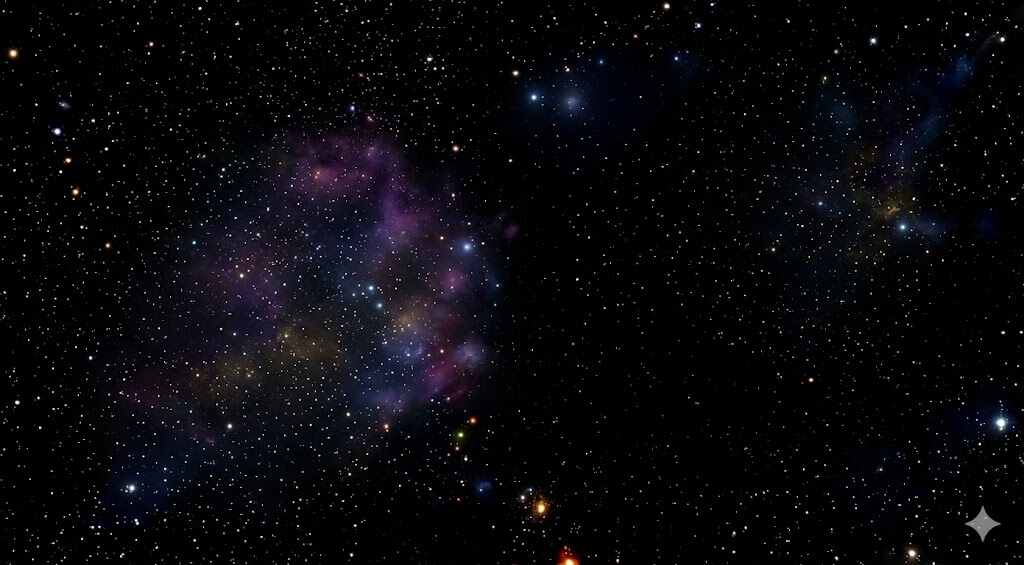
On a perfectly ordinary evening in 1823, inside a study in Bremen, Germany, an astronomer named Heinrich Olbers sat by his window, staring out into the deep, pitch-black abyss of the night sky. As he wiped down the lens of his telescope, a seemingly childish question suddenly popped into his head—the kind of question only a kid would think to ask:
"Why is the night sky black?"
If anyone else had been in the room at that moment, they would have laughed him out of the study: "Olbers, are you losing your mind? The Sun goes down at night. Of course the sky is black!"
But Olbers wasn't laughing. In fact, a cold sweat broke out across his forehead. As one of the leading scientists of his era, he knew that in the grand framework of 19th-century physics, the darkness of the night sky was not common sense at all. It was a phantom illusion—a glaring logical dead end that was about to drive the scientific world mad.
This became known to history as "Olbers' Paradox."
To understand the sheer desperation scientists felt back then, we have to travel back to the 1800s. At the time, from Sir Isaac Newton down to every university physics professor, the textbooks dictated three sacred, undeniable "cosmic truths":
- The universe is infinite (it has no boundaries).
- The universe is eternal and static (it has no beginning and no end).
- Stars are infinite in number, scattered evenly throughout endless space.
These three assumptions sounded absolutely perfect and entirely intuitive, right? Yet, with a simple analogy jotted down on a piece of paper, Olbers brought the walls of this flawless scientific fortress crashing down.
Olbers argued: Let's use our eyes as an example. Imagine you are standing dead-center in an infinite forest. You turn your body and look in any direction. No matter where you point your gaze, your line of sight will eventually hit a tree trunk, won't it? Because the trees are infinite, they layer upon layer until they completely saturate your field of vision.
Now, swap the forest for the universe, and the trees for stars. If the universe is infinite and stars are countless, then no matter which microscopic geometric point in the night sky you look at, your line of sight must eventually slam into the surface of a star.
"But wait," someone might object, "distant stars look incredibly dim!" Olbers smiled and crunched the numbers: True, as a star gets farther away, its individual brightness fades. However, as you look further out, the sheer volume of stars within that wider boundary increases exponentially!
The astronomical explosion in quantity perfectly counteracts the decay caused by distance.
According to Newton and every scientist of that era, the moment we look up, every single square inch of the night sky should be crammed with stars. The entire night sky should fuse into an unbroken, blinding wall of white-hot fire—tens of thousands of times brighter than the midday Sun! Every single night, the Earth should be incinerated by a relentless, interlocking sea of starlight!
The moment this deduction hit the scientific community, physics went into a collective frenzy. Scientists couldn't accept that their grand theories couldn't even explain why the dark existed. To patch this fatal flaw, they began frantically inventing excuses:
Some suggested: "It's because of interstellar dust! Cosmic dust blocks the distant starlight!" (This was quickly debunked by the laws of thermodynamics: if dust is bombarded by starlight day in and day out, it will eventually heat up until it glows like a branding iron. The sky would still be blindingly bright.)
Others muttered: "Well, maybe the distant stars just haven't filled in the gaps yet..."
For over a hundred years, this paradox hung over the necks of physicists like an unyielding ghost. When the Sun rose during the day, the world felt sane; but the moment twilight faded into a pitch-black night, that darkness felt like a mute, mocking reminder of the limits of human knowledge.
It wasn't until the twin hammers of modern physics came swinging down that humanity finally realized: the darkness of the night is actually the universe's most gentle deception.
How exactly does the universe pull off this cosmic magic trick—taking an infinite ocean of blinding starlight and making it disappear?
Albert Einstein and Edwin Hubble later proved that the first two assumptions in the old textbooks were dead wrong. The universe is not eternal; it has a definitive beginning, born 13.8 billion years ago in the Big Bang.
This introduces a lethal cosmic speed limit: the speed of light is finite. Since the universe has only been around for 13.8 billion years, the countless stars residing further than 13.8 billion light-years away are still casting their light through the dark. That light is running a frantic marathon, but it simply hasn't had enough time to reach Earth yet!
In an instant, the number of stars we can actually see plummets from "infinite" to "finite." The first defensive shield of the night is established.
But even that isn't enough. The stars residing strictly within our "observable universe" are still massive in number, and their combined glow should still turn the night sky into a brightly lit dome. Why does it still look pitch black?
Because space itself is expanding at a blistering pace. The incredibly brilliant, blinding light emitted by those distant stars must travel through a fabric of space that is being violently stretched out. As it travels, the wavelength of the light is stretched along with it. Think of it like a tightly coiled spring being ruthlessly pulled apart from both ends.
Through this relentless cosmic stretching, all that blinding visible light is dragged out of our sight, transformed into infrared light and microwave background radiation—wavelengths completely invisible to the naked human eye.
Epilogue: The Universe's Most Romantic Camouflage
The grand plot twist of the story is this: the night sky isn't black at all. In the spectrum of invisible light, it is actually a roaring, multicolored ocean of fire.
If human eyes were hardwired with built-in infrared and microwave vision, the moment you looked up at night, you would be instantly blinded by the overwhelming, wall-to-wall leftover radiation of the cosmos.
The universe tells a magnificent lie. By weaponizing the expansion of space and the cosmic speed limit of light, it creates a beautifully protective camouflage. It filters, stretches, and hides the very energy that would otherwise vaporize our planet ten thousand times over, tucking it safely away into the illusion of nothingness.
Whenever you look up at the quiet, deep serenity of the night sky, take a moment to thank Heinrich Olbers for his question. Because that darkness isn't a sign of an empty void; it is the universe using its grandest laws to carefully shield life on Earth from the brilliant, lethal fury of the deep cosmos.
Keep exploring
When you want adjacent angles on Earth, the theme hub rounds up sibling articles in the same editorial voice. The full archive helps you compare how topics evolve as new missions and surveys release data.