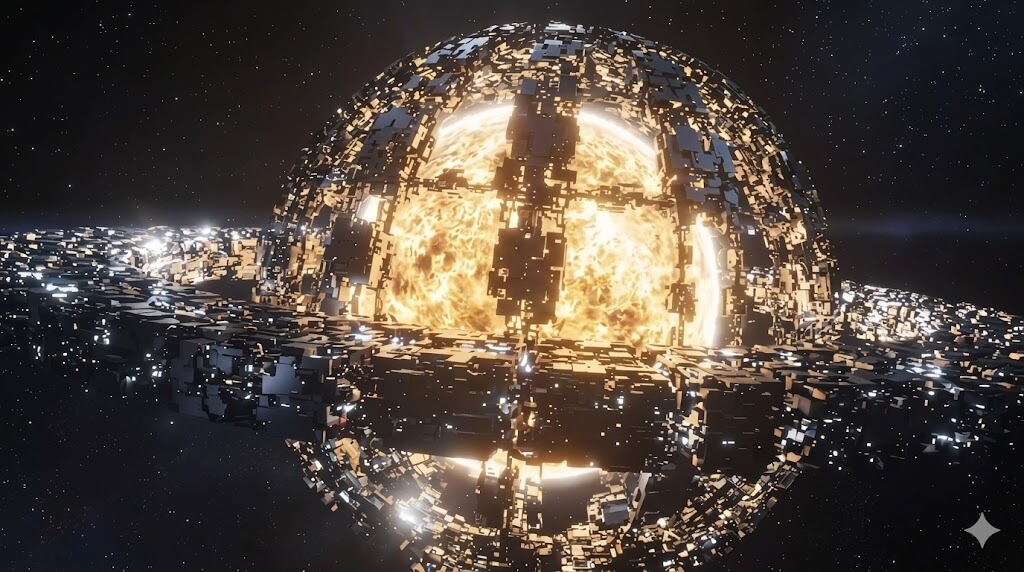
Deep in the icy silence of the cosmos, countless stars have flickered like grains of sand for billions of years. Yet, a bone-chilling question has haunted humanity like a phantom: If the universe is packed with prime real estate, and the odds of god-like civilizations emerging are astronomically high, where is everybody? Why hasn't anyone dropped by Earth for a visit?
Back in 1950, physicist Enrico Fermi blurted out during lunch, "Where is everybody?" That single question tore away the deepest curtain of the cosmos, leaving behind the "Fermi Paradox"—a riddle that gets more terrifying the more you think about it. If you piece together the clues scattered across deep space, you'll find that the reason aliens haven't visited Earth is not only cold and ruthless, but it also carries a heavy dose of dark humor.
This cosmic horror story kicks off with a rogue visitor pulling off the ultimate interstellar speeding violation.
In the late autumn of 2017, humanity's telescopes suddenly spotted a highly suspicious character. Shaped like a giant, ancient cigar and glowing with a strange reddish hue, it was hurtling through our solar system at a completely mind-boggling speed. Scientists named it 'Oumuamua—Hawaiian for "a messenger from afar." To make things even weirder, as it was making its exit out of the solar system, it inexplicably "stepped on the gas" and accelerated, completely defying the laws of gravitational pull!
Avi Loeb, the chair of Harvard's Astronomy Department, couldn't sit still. He boldly suggested that this was no ordinary space rock. It was highly likely an alien probe, or perhaps a piece of high-tech space junk—the drifting wreckage of an alien light sail—floating through the void.
Yet, it came and went in a flash. It didn't give a single damn about humanity—with all our frantic conferences, breaking news alerts, and chaotic videos—and simply vanished into the deep dark without so much as a backward glance. The 'Oumuamua incident exposed a deeply humbling truth: Aliens might have visited, or at least passed by, but they didn't think we were even worth a polite nod.
To super-civilizations that have evolved over millions of years—ones that can power their entire world just by tapping into a galaxy like a AA battery—Earth's tech level is practically a mud hut without an internet connection. The resources we hoard like buried treasure—oil, gold, even the water that sustains our very lives—are incredibly common in the grand scheme of the universe, no scarcer than the dirt on a roadside.
This brings us to the brutal reality of "Earth's insignificance." Aliens avoiding Earth is a lot like you driving a Tesla down the highway at 80 mph. You aren't going to slam on the brakes, jump out, and hand a business card to an anthill just to discuss "inter-species synergy." There's a bizarre sense of security in being completely ignored, but it sure does leave our planetary ego bruised and battered.
But that's not even the most unsettling part. What truly sends a shiver down your spine is the famous "Zoo Hypothesis."
According to this theory, the aliens have already stripped us of our secrets. Advanced civilizations have drawn an invisible boundary around our solar system, turning Earth into a "galactic wildlife sanctuary."
Right this second, a bunch of tentacled horrors or silicon-based lifeforms might be chilling in a high-dimensional spaceship, sipping on the alien equivalent of a cold soda, and staring at us through a pane of invisible "one-way glass" like we're monkeys in a cage. They watch us tear each other to pieces over tiny patches of land, and they chuckle at our pathetic attempts at high technology. They don't make contact simply because the galactic rulebook says: "Do not feed or interact with the humans; let them evolve naturally." We think we're the pinnacle of creation, but we might just be the content for a low-tier cosmic reality show.
If being treated like zoo animals makes you feel a little pathetic, Liu Cixin's "Dark Forest Theory"—popularized in his sci-fi epic The Three Body Problem—turns this cosmic daydream into a full-blown midnight thriller.
The universe is a dark forest, and every civilization is a armed hunter. In a world where immense distances make communication impossible and suspicion unavoidable, the ultimate survival strategy is simple: keep your mouth shut. The moment you detect another sign of life, the safest move isn't to say hello—it's to pull the trigger and wipe them out before they can do the same to you.
Yet, for the past century, humanity has acted like a screaming toddler in the pitch-black woods, blasting radio waves and "cosmic signals" into the deep dark. Luckily for us, in a universe measured in tens of thousands of light-years, our signals have barely traveled anywhere at all. It's like pouring a single drop of ink into the Pacific Ocean and wondering why the fish on the other side haven't noticed. We haven't taken a bullet to the head yet simply because the hunters in the dark haven't chanced upon our tiny, flickering firefly of a planet.
At the end of this tale lies the ultimate, bleakest judgment regarding our "unknown future"—the Great Filter.
The most disturbing answer to the Fermi Paradox is that every civilization, upon reaching a certain milestone, hits a catastrophic wall and undergoes a total "system format" before they can become a true interstellar species. Whether they destroy themselves in a nuclear apocalypse, lose control of an AI rebellion, or simply hit an unbreakable wall in the laws of physics, they never make it through.
If this Great Filter lies dead ahead in humanity's future, it means those grand, arrogant alien civilizations of the past never even got around to booking a ticket to Earth. They all perished in the self-inflicted ruins of their own home planets. And humanity is currently skipping down that exact same path, happily marching straight into a cosmic trap.
In this grand drama of universal silence, humanity's biggest mistake is assuming we are the stars of the show. Beyond these ruthless hypotheses lies an explanation that is far more absurd and mundane: the law of cosmic economics.
We imagine advanced civilizations possess infinite resources and an endless appetite for adventure. But cold science smiles awkwardly at this idea. Crossing dozens or hundreds of light-years requires an astronomical budget of pure energy. For any rational civilization looking for a return on investment, burning half a star's worth of energy to fly for centuries just to look at a species that hasn't even figured out commercial nuclear fusion is an absolute nightmare for their accounting department. Instead of braving the void, they'd rather plug into a matrix powered by their own sun and enjoy eternal, digital bliss. We are looking for gods, but the gods might just be soaking their feet and playing video games at home, entirely unwilling to leave the couch.
Even more ironically, maybe the Great Filter isn't a bloody, dramatic apocalypse. It might not be a blinding nuclear blast or a rogue AI. It could be a gentle, comfortable trap: the ultimate "low-desire society." When a civilization's tech becomes advanced enough to rewrite genomes and perfectly control dopamine levels, exploring the real world loses all its charm. Why endure millennia of crushing loneliness inside a tin-can spaceship to explore a freezing, dead universe when you can conjure ultimate euphoria with a single thought? Thus, at the very peak of their technological golden age, countless advanced civilizations may have chosen to lay down, opt out, and quietly fade away in the cozy cradles of their home worlds.
Look back at us. We call ourselves the "pioneers of the cosmos," yet we spend our days screaming at each other over trivial nonsense on social media, playing a dangerous game of chicken on our tiny terrestrial laboratory. We tremble in fear of being sniped by a hunter in the dark forest, while simultaneously acting like a hopelessly desperate lover, shouting into the empty night sky: "Hey, is anybody out there?"
In this cosmic monologue, without an audience or an adversary, the fact that aliens haven't arrived might just be the greatest mercy the universe could offer us. It serves as a massive blank canvas, forcing us to drop our arrogance and learn humility in the face of an unknown and perilous future. Since no savior is falling from the heavens, and no destroyer has checked in on their schedule, humanity's only choice in this freezing, primordial desert of space is to grip the steering wheel and floor the accelerator. Before our own system gets formatted, even if we are heading straight for a cliff, we might as well spark the brightest, most magnificent fire the galaxy has ever seen.
Keep exploring
When you want adjacent angles on Earth, the theme hub rounds up sibling articles in the same editorial voice. The full archive helps you compare how topics evolve as new missions and surveys release data.