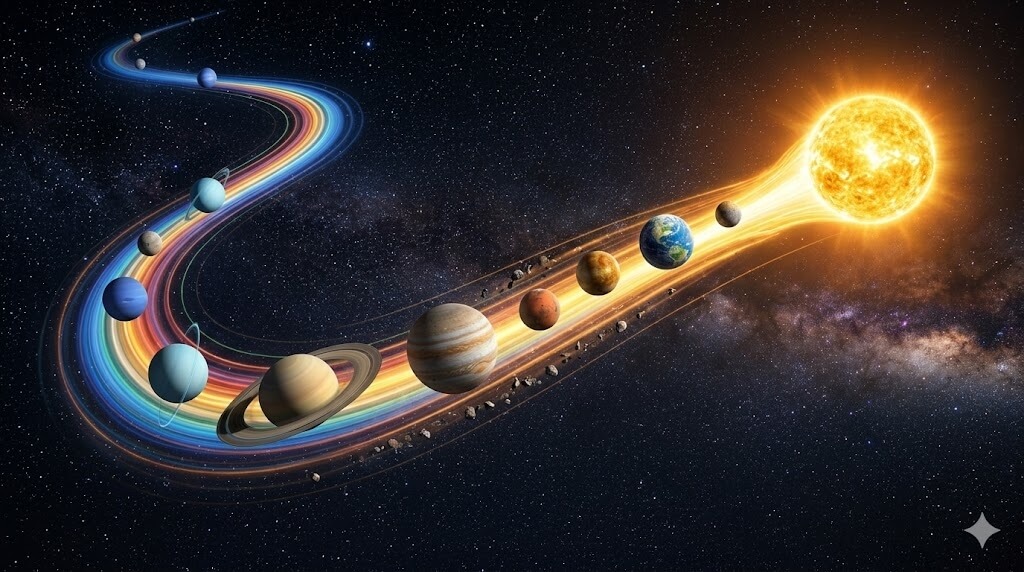
Since childhood, the diagrams of the solar system in our textbooks have always resembled a flat vinyl record—the sun sits comfortably at the center, completely stationary, while the eight planets dutifully trace out perfect concentric circles in their respective orbits. However, this is merely a static, oversimplified representation designed to make teaching easier.
If we pull our perspective back to a much grander cosmic scale, we will discover that the true trajectory of the solar system has never stood still for a single second. It is a stunning, breathtaking helical structure.
In this authentic "warp speed" mode, the sun is no longer a passive spectator sitting at the center of the stage. Instead, it is hurtling forward at a staggering speed of approximately 220 kilometers per second through the Orion Arm of the Milky Way, dragging every single member of the solar system along with it.
When the stationary center becomes a full-throttle vanguard, the Earth's orbit around the sun combines with the sun's forward velocity. Together, they morph into a helix—a spiral line that perpetually stretches forward into the void of space, never to close upon itself.
This means that not a single second is ever repeated. The Earth is not just revolving around the sun; it is being dragged headlong by it, racing toward the deepest recesses of the universe.
It is a 7-billion-kilometer journey through spacetime every single year. Each time a year passes, we mistakenly believe we have "returned to the starting point" to celebrate birthdays or ring in the New Year. In truth, we have only returned to a relative position concerning the sun. In the absolute coordinates of the universe, that starting point from a year ago has long vanished into the freezing, dark abyss of deep space, never to be reclaimed. Every moment of our lives marks the very first time humanity—and indeed the entire history of the Earth—has ever arrived at that precise cosmic coordinate. There is no turning back, not even for a single second.
When we travel on a commercial airliner, watching the clouds and the ground flash by outside the window, we already feel like we are moving at an incredible speed. While cruising, a commercial jet covers about 250 meters per second—traversing more than two football fields in the blink of an eye—at a top speed of 900 kilometers per hour.
Yet, once this pinnacle of human technological speed is placed against the backdrop of the cosmic scale, it appears as agonizingly slow as a snail's crawl.
At this very moment, the sun is carrying us forward through the galaxy at a terrifying speed of 220 kilometers per second. That is 220,000 meters per second—exactly 880 times faster than a commercial airliner!
This creates an exquisitely surreal juxtaposition: as you sit on a plane, looking out the window, you advance a mere 250 meters in one second. Yet in that exact same second, the sun has already teleported you, the entire aircraft, and everything else on Earth across 220 kilometers of deep space. For the commercial airliner you are gazing out of to cover that distance under its own power, it would have to fly non-stop for nearly 15 minutes.
Hence, herein lies the most romantic truth of all—we constantly assume we are sitting securely in our chairs, remaining in one spot, but the reality is that everyone is born with an automatic, non-stop ticket on the fastest express train in the universe.
If you could freeze yourself in the vacuum of space and watch the solar system roar past, you would not see a static portrait. Instead, you would witness a brilliant star leading the charge, with the eight planets trailing long, spiral wakes behind it like a colossal dragon tearing through the dark night, vanishing in a flash into the deep space tens of billions of kilometers away. This is the world we actually live in.
As this dragon barrels forward, time itself stretches infinitely within the cosmic clock.
Even though the solar system is hurtling at 220 kilometers per second, the Milky Way is so incomprehensiously massive that it takes the sun roughly 225 to 250 million years to complete a single revolution around the galactic center. In astronomy, this immense duration is given a beautiful, poetic name: a "Galactic Year."
If we use the scale of a Galactic Year to review the history of the Earth, all human grievances and anxieties evaporate into nothingness:
Exactly one Galactic Year ago, the very first dinosaurs were just emerging on Earth; they had not even had the time to dominate the planet yet.
Two Galactic Years ago, the Earth underwent a cataclysmic mass extinction—the Permian-Triassic extinction event. The entire ecosystem was just beginning to reshuffle, and the ancestors of dinosaurs were nowhere to be found.
And twenty Galactic Years ago, there was no multicellular life whatsoever on Earth—only a desolate primordial ocean inhabited by single-celled microorganisms.
As for the human species, from our dawn to the present day, a mere 0.001 of a Galactic Year has elapsed. Converted to the clock of the universe, our species was born just a few minutes ago.
This adds a profound weight to the phrase, "not a single second is a return to the original path." Our lives, which we perceive as long, winding, and fraught with complications, amount to less than a microscopic spark struck by the solar system as it blazes through the universe.
Logically, since the solar system is barreling through the universe like a dragon at such a frenetic pace, the scenery we see along the way—such as the famous Big Dipper—should be racing backward like trees outside a train window. Why, then, throughout thousands of years of human history, has the position of the Big Dipper appeared almost entirely motionless?
The answer to this mystery is locked within the profound logic of the cosmos. First is the matter of distance and scale. When we ride a high-speed train, the telephone poles by the tracks flash past in an instant, while the distant mountains seem to move at a sluggish crawl. In the universe, this principle is magnified by trillions. The 7 billion kilometers the solar system travels in a year sounds like an astronomical figure, but the stars of the Big Dipper are located roughly 70 to 120 light-years away from us.
If we scale this distance down proportionally—assuming the 7 billion kilometers the solar system travels in a year is equivalent to an ant crawling forward by just 1 millimeter—then the Big Dipper sits over 100 kilometers away from that ant. For an ant that has crawled a mere millimeter, looking at a mountain 100 kilometers away, the mountain's bearing will not alter in the slightest.
Second, those stars are running too, and we are all part of a "grand cosmic caravan." Nothing in the universe is truly stationary; the stars of the Big Dipper are themselves moving at high speeds. Fascinatingly, five of the seven stars in the Big Dipper actually belong to the exact same stellar group. Like the sun, they are revolving around the galactic center in the exact same direction. It is just like several cars driving side-by-side down a highway in the same direction; even though each car is traveling at hundreds of kilometers per hour, because their direction is identical and their speeds are similar, they appear to one another as if they are staying in the same relative positions.
Finally, there is the span of time. Does the Big Dipper truly never change its position? The answer is: it changes constantly, but human lifespans and history are simply too brief for our eyes to perceive it. Astronomers have calculated that each star in the Big Dipper possesses slight variances in its direction and speed of motion. Over a timescale of 100,000 years, the shape of this cosmic ladle will completely disintegrate.
One hundred thousand years ago, when our ancestors were still rubbing sticks together to make fire, the Big Dipper resembled a straight, pointed spear. We in the modern era just happen to catch them at a moment in their journey where they form a perfect "big ladle." Yet, 100,000 years from now, because they are flying off in different directions, this ladle will be completely warped and stretched into a distorted arrowhead.
Thus, it is not that the Big Dipper does not move; it is that the clock of the universe ticks too slowly. The few thousand years of human civilization amount to less than a snapshot in a cosmic river that flows for billions of years. In this briefest of flashes, the roaring dragon that is our solar system has not yet had enough time to break the relative spacetime stillness shared with the Big Dipper.
And so, we live our lives wrapped inside this tiny, beautifully shielded cocoon of relativity—hurling through the dark night alongside the stars, while peacefully spending each irreplaceable today.
Keep exploring
When you want adjacent angles on Solar System, the theme hub rounds up sibling articles in the same editorial voice. The full archive helps you compare how topics evolve as new missions and surveys release data.