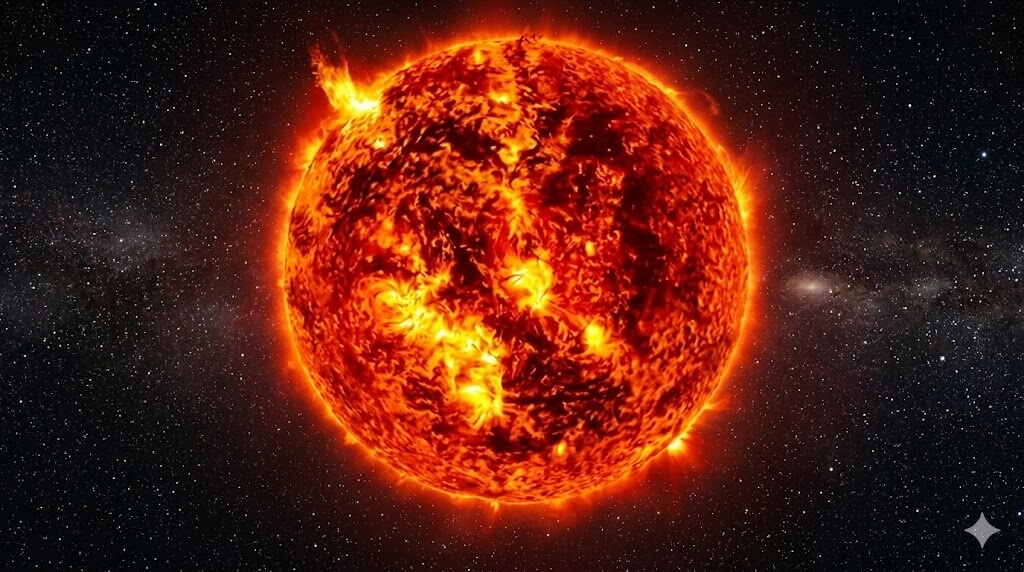
On the vast and silent stage of the universe, all life on Earth basks in the warmth of the sun. Yet, few realize that this brilliant star suspended above us—the very life-support system of our solar system—is actually a meticulously precise, colossal, and frantically ticking "cosmic time bomb."
This breathtaking act of "suicidal combustion" has been raging for a staggering 4.6 billion years. If we could zoom in, piercing the sun's dazzling white shroud to peer directly into its central purgatory, we would find a ledger with an agonizingly immense running total ticking up every single second. Deep within the solar core, crushing pressure fuses hydrogen nuclei into helium-4 at a frantic rate of roughly 600 million tons per second, leaving behind 596 million tons of helium.
In this cosmic crucible of high-pressure nuclear fusion, 4 million tons of matter vanish into thin air every second. According to Einstein's mass-energy equivalence equation (E=mc 2), this missing mass is not destroyed; rather, in the blink of an eye, it is converted entirely into pure, cataclysmic energy. This energy erupts from the sun as an infinite torrent of photons. The infinitesimally small fraction of this light that travels 150 million kilometers to strike Earth is enough to sustain every living soul on our planet. In essence, the sun is prolonging the life of the solar system by "carving away 4 million tons of its own flesh" every second.
Since it grows lighter with each passing second, many might wonder: Will the sun eventually burn itself down to nothing? Scientific projections offer a much colder reality: it won't even live to see the day it runs out of fuel. Instead, it will "detonate" prematurely—and that is the true nature of this cosmic time bomb.
Inside the sun, two titans are locked in eternal combat. A colossal gravitational pull desperately crushes all matter inward, while the energy unleashed by nuclear fusion violently pushes outward. For now, these two forces are perfectly matched. However, as the hydrogen fuel in the core inevitably runs dry, this balance will shatter. When the core collapses under its own weight, causing temperatures to skyrocket, the sun's outer envelope will begin to violently expand. The sun we know today—a mild-mannered "youth in white"—will balloon into a dying, bloated behemoth millions of times its original volume: a Red Giant. It will open its ravenous maw to swallow Mercury and Venus, eventually engulfing Earth itself in a belly of searing plasma.
Hearing this, you might breathe a sigh of relief, thinking: "Isn't the sun's red giant phase still 50 billion years away? Humanity has plenty of time." However, the bomb's most merciless secret lies hidden inside its fuse. Humanity's final deadline to flee Earth is not 50 billion years—it is a mere 1 billion.
As it marches toward its ultimate demise over the eons, the sun is quietly "running hotter." As more and more "helium ash" accumulates in the core, the solar reactor becomes increasingly intense. Scientists have calculated that the sun's luminosity increases by roughly 10% every billion years.
Never underestimate the power of that 10% increase. In about a billion years, this extra radiation will utterly shatter Earth's ecological balance. The global greenhouse effect will spiral completely out of control, surface temperatures will skyrocket, and Earth's oceans will begin to boil and violently evaporate.
Soon after, brutal ultraviolet radiation will mercilessly tear those airborne water molecules apart into hydrogen and oxygen, allowing the lightweight hydrogen gas to bleed off into the vacuum of space. That will be Earth's final chapter: a world stripped of its last drop of water, reduced to a molten purgatory just like Venus, with surface temperatures hovering at hundreds of degrees Celsius. On a future Earth with no water and ground like red-hot iron, no complex life could survive for even a second. Therefore, Earth's habitability will collapse entirely long before the sun swallows it.
Fortunately, the fuse of this time bomb is remarkably long. This 4.6-billion-year suicidal burn has granted Earth enough time for life to evolve from single-celled organisms in primordial oceans into human beings—creatures capable of gazing at the stars and calculating the lifespan of the sun.
Facing this 1-billion-year ultimate countdown, humanity has only two choices: either build planetary engines to sail Earth away from the solar system, much like the premise of The Wandering Earth, or leverage advanced future technology to construct colossal interstellar arks, migrating toward distant yet safe exoplanets like LHS 1140 b.
The sun's red giant apocalypse will inevitably come. Humanity's destiny in the cosmos hinges entirely on whether we can master the keys to interstellar travel before this massive time bomb detonates, securing our next eternal home in the deep recesses of the starry sea.
Keep exploring
When you want adjacent angles on Solar System, the theme hub rounds up sibling articles in the same editorial voice. The full archive helps you compare how topics evolve as new missions and surveys release data.