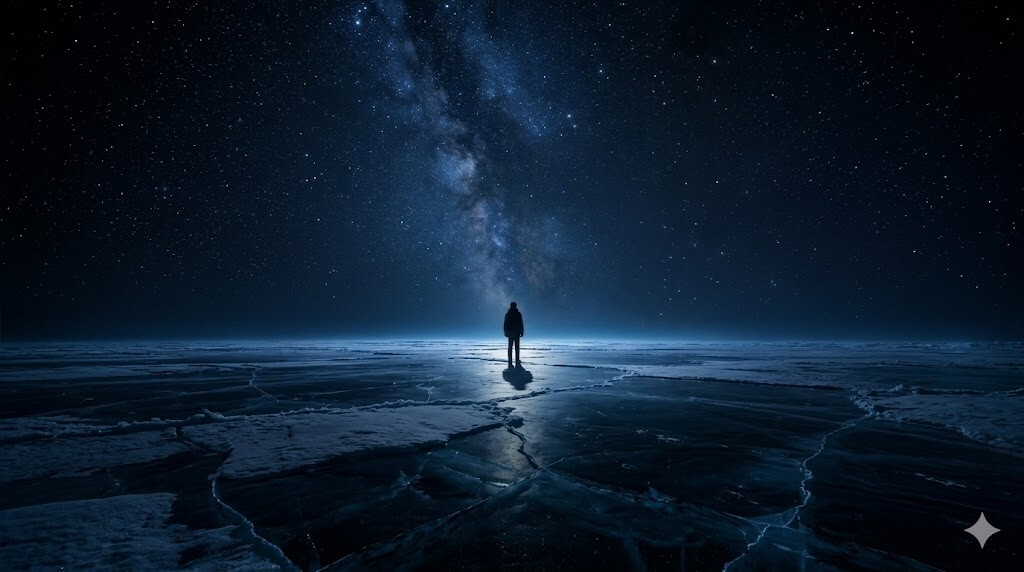
If the sun were to suddenly extinguish today with absolutely no warning, the world would not plunge into panic in the very first second. At this exact moment, you might be looking at the sunshine outside your window, the streets would still be bustling with traffic, and the tea in your hand would still be steaming hot. Because it takes time for both light and gravity to traverse the vast void of space, everything on Earth would carry on as usual during these final eight minutes and twenty seconds. No one would realize that doomsday had already entered its countdown.
It wouldn't be until the eight-minute-and-twenty-first second that the world would be completely upended in an instant.
Darkness would abruptly swallow the globe. This wouldn't be the gentle twilight of a normal sunset, but rather as if some cosmic hand had flipped a switch and shut down the power grid of the universe. In that same blink of an eye, the moon and the planets across the night sky would vanish into thin air—for the sunlight they relied on to reflect would no longer exist.
Yet, far more terrifying than the sudden, absolute darkness would be the unbuckling of gravity. The gravitational waves that held the solar system together would vanish at the speed of light, and the Earth would instantly break free from its orbital tracks. Our once-proud "Spaceship Earth" would become like a racecar whose steering wheel snapped on a highway, hurtling at a ferocious speed of 30 kilometers per second straight into the freezing, dead void of the Milky Way. That grand cosmic dragon, led by the sun with the eight planets trailing long, spiral wakes in its path, would disband forever today. There would be no turning back, not even for a single second, as Earth embarked on a true journey of interstellar drifting.
In the days that followed, panic and hysteria would sweep the globe. Without sunlight, photosynthesis would ground to a halt; every plant on the surface would cease releasing oxygen within days and begin dying off in droves. Though the oxygen trapped in our atmosphere would be enough to sustain human respiration for thousands of years, the collapse of the food chain would be irreversible.
Immediately after would come a desperate, cliff-like plunge in global temperatures.
By the end of the first week, the global average temperature would drop to around 0°C. Within months, that number would plummet further to a staggering minus 100°C. Every river and lake would freeze solid in a matter of days, and before long, even the surface of the vast global oceans would be locked beneath a thick armor of ice. On land, power grids would violently crash under the extreme cold, and the vast majority of humans and mammals, unable to secure a source of heat, would be frozen to death on the surface within the opening weeks.
The true suffocation would lie further down the road. A few years later, when temperatures fell below minus 200°C, the very atmosphere that protects us would no longer hold up. The nitrogen and oxygen in the air would begin to liquefy and freeze, falling from the sky like a prolonged, hopeless, and silent snow. The surface of the Earth would ultimately become an absolute wasteland of silence—devoid of air, devoid of sound, and blanketed in a crust of solid atmosphere.
Amid this total, suffocating apocalypse, the last survivors of human civilization would be forced to retreat into the deepest recesses of the earth.
The once-thriving cities of old would be locked in ice on the surface, leaving deep underground bunkers powered by geothermal and nuclear energy as humanity's sole path to survival. Regions naturally rich in geothermal resources, like Iceland, would become mankind's final Noah's Arks.
In these steel metropolises buried miles beneath the surface, humans would use artificial light to simulate sunshine, grow hydroponic crops in greenhouses, and scrape by on the residual warmth of a planetary core that had not yet cooled. Here, there would be no seasons and no sunrises; survival would become the only KPI that mattered. Humans wouldn't even dare to return to the surface lightly, for every trek up to "shovel snow"—which in reality meant harvesting frozen blocks of oxygen and nitrogen—would be a suicidal dance on the edge of absolute zero.
Yet, while humanity struggled bitterly in underground shelters for a single kilowatt-hour of power or a sip of water, another miracle of life would be playing out in the deep oceans of the Earth.
Though the surface of the oceans would be completely sealed under hundreds of meters of ice, this thick icy crust would actually act like a massive blanket, preventing the seawater beneath from radiating its heat out into space. For hundreds of thousands of years, the deep ocean below the ice armor would remain liquid.
More importantly, the deep sea holds Earth's most hardcore wildcard—hydrothermal vents, the "black smokers" spewing heat from the core of the planet.
Life here has never needed the sun. Extremophile microbes living around these thermal vents rely on the sulfides churning from the Earth's core for chemosynthesis, sustaining an ecosystem of blind shrimp, giant tube worms, and bizarre crabs in the deep. For them, the disappearance of the sun on the surface would mean nothing more than an extra layer of ice overhead; their grand drama of life would continue to play out boisterously in the pitch-black depths. Even if humanity went entirely extinct, the deep-sea ecosystem could survive independently in the dark for billions of years.
Stripped of its sun, the Earth would no longer be a planet; it would become a "rogue planet," drifting lonely through the dark.
For the next few billion years, this frozen blue marble would wander blindly through the freezing, silent interstellar space. In the end, its fate would boil down to only two possibilities:
Either, during its long drift, the Earth would accidentally collide with another star, or be swallowed by a merciless black hole, meeting its ultimate, shattering end in a brilliant burst of cosmic fireworks;
Or, against astronomical odds, after drifting for countless light-years and living through countless Galactic Years, the Earth would be luckily captured by a young, warm star.
If that day ever came, the light of a new sun would once again illuminate this sleeping world. The surface ice would begin to melt, and the atmosphere that had been frozen for eons would thaw back into howling winds. By then, if the descendants of humanity still endured in those underground sanctuaries and stepped onto the surface to witness a brand-new dawn for the very first time, they would realize that the great dragon once led by the sun had, in the dark nights following today, long left behind a homeland to which they could never return.
Keep exploring
When you want adjacent angles on Solar System, the theme hub rounds up sibling articles in the same editorial voice. The full archive helps you compare how topics evolve as new missions and surveys release data.