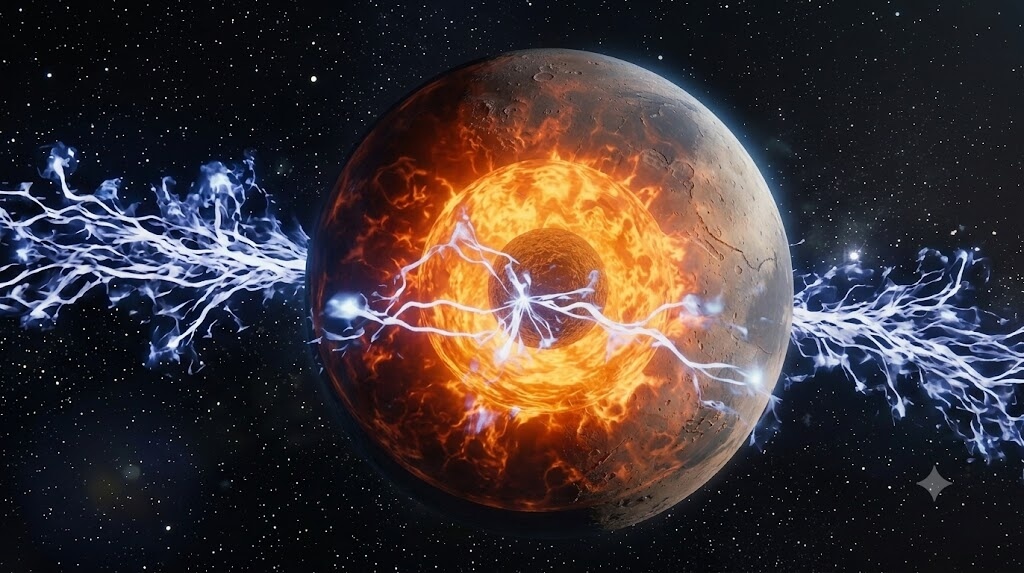
In the original script, the diagnosis scientists gave to Mars was utterly hopeless.They told us that Mars had "died" completely around 3.5 billion years ago. Its small body simply couldn't hold onto its heat, and that iron-and-nickel core deep inside had long since solidified into a chunk of ice-cold, rigid rock. Without a churning core, the Martian magnetic field stalled, its atmosphere was stripped away, and its oceans evaporated into the void. In the eyes of humanity, Mars was nothing more than a colossal planetary corpse hanging in space.
For humans, going to Mars felt less like an exploration and more like archeology—a trek into a cosmic tomb that had been abandoned for eons.
That was until recently, when NASA's probes—most notably InSight, which spent years listening to the planet's "heartbeat"—sent back data that made scientists rub their eyes in disbelief. After analyzing the numbers, they slapped their foreheads and exclaimed, "Wait a minute! The old timer still has a pulse! It isn't dead—it's just taking a nap!"
The turning point of this new narrative begins with the volcanoes.We used to believe that the super-volcanoes of Mars—including Olympus Mons, the largest volcano in the solar system—had been extinct for countless millennia. However, recent discoveries have revealed thick, incredibly fresh layers of hardened lava draping across certain Martian plains and volcanic provinces.
Just how fresh? Roughly two million years old.
To us humans, two million years sounds like an eternity. But if you compress the solar system's 4.6-billion-year history into a single 24-hour day, two million years is nothing but the final few seconds before the midnight bell tolls. In other words, just "yesterday" in Martian time—when our own ancestors were already walking upright on Earth—the underground of Mars was still violently erupting with blazing magma!
Even more thrillingly, InSight captured frequent "marsquakes" originating over a dozen kilometers beneath the surface. These weren't ordinary seismic rumbles; they were the echoes of molten rivers of magma surging and breathing through deep subterranean fissures.
The Martian core has not entirely cooled. Deep within a heart once presumed dead, a flicker of an ancient fire still burns.
What does this four-word realization—"the core isn't dead"—actually mean for humanity?It means that the ultimate physical gateway to resurrecting Mars has not been permanently welded shut.Think about it: in the past, whenever we discussed terraforming Mars, what was the source of our deepest despair? It was always the lack of a magnetic field. If the core were dead, any atmosphere we painstakingly manufactured on the surface would just be swept away by the solar wind—as futile as pouring water into a bucket riddled with holes.
But now, the baseline conditions have fundamentally shifted.
The rotation of Mars is practically identical to Earth's. And now we know that deep below, it still harbors unsolidified, conductive fluid—molten iron and nickel. As long as you have these two essential ingredients—rotation and a liquid core—the "planetary dynamo" capable of generating a magnetic field is ready to be switched back on.
Mars is like a vintage car parked on a slope. The engine has stalled, but the motor isn't broken, and there's still gas in the tank. It just needs an external push to pop the clutch and spark it back to life.
In the future, humanity might not need to play the role of an all-powerful God creating a world from scratch. Instead, we can act as brilliant engineers. Whether we deploy massive magnetic shield satellites into orbit to deflect the solar wind, or use advanced tech to provide targeted heating to the Martian core, we just need to re-ignite that internal magma convection. Do that, and the magnetic field of Mars can be brought back from the dead.
Keep exploring
When you want adjacent angles on Solar System, the theme hub rounds up sibling articles in the same editorial voice. The full archive helps you compare how topics evolve as new missions and surveys release data.