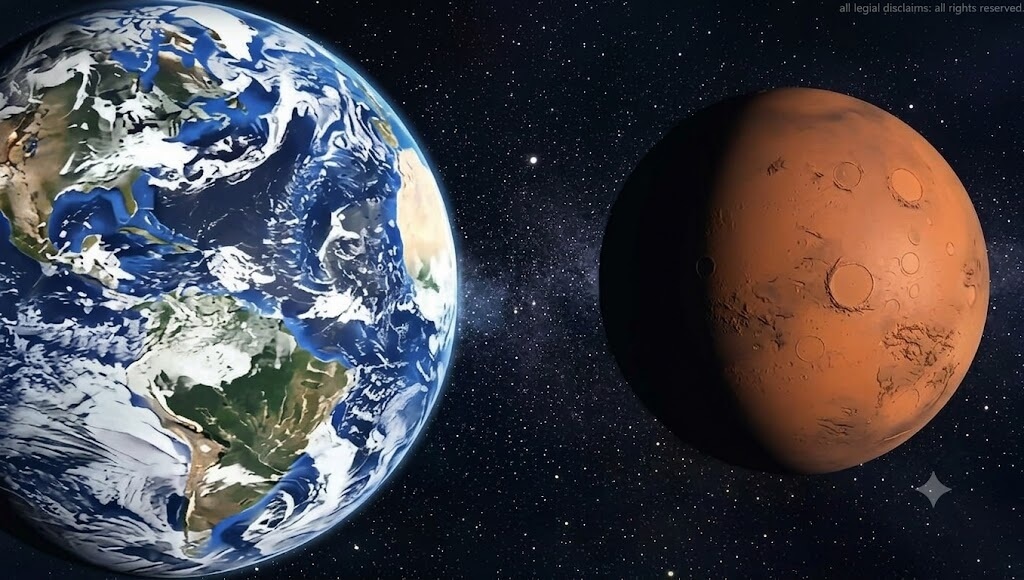
Four billion years ago Mars may have outpaced Earth as a cradle for life—today its frozen desert is a planetary cold case and a climate mirror.
This long read belongs to VortexCelest’s Mars tour, grouped under “Planetary history.” We keep one foot in mission logistics and another in the classroom—so trajectories, surfaces, and space weather never drift into mythology.
Twin planets—and a warning carved in red dust
Four billion years ago, if you peered into the solar system from the deep void of space, the most dazzling twin stars would have been none other than Earth and Mars. In fact, at that time, Mars boasted conditions far superior to Earth's, making it the premier cradle for the dawn of life.
Yet today, Mars has withered into a frozen, barren, reddish-brown desert. Hanging in the void like a colossal planetary corpse, it gazes coldly down upon Earth—serving as the ultimate warning for the fate of our own world.
How did this global tragedy unfold? Let us reopen the ultimate cold case: the death file of Mars.
Mars in its infancy: an absolute paradise
Beating Earth to the starting line of life: four billion years ago, Earth was trapped in the twilight of the Hadean Eon—relentlessly battered by giant asteroids, its surface a chaotic sea of molten lava. Mars, however, being smaller in size, dissipated its heat much faster. Its crust cooled down first, stabilizing long before Earth did.
Vast oceans and a thick atmosphere: the Martian world back then was blanketed by an atmosphere a hundred times denser than it is today. A robust greenhouse effect kept the planet comfortably warm. The northern hemisphere of Mars was home to a sprawling, majestic ocean—ancient shorelines, outflow channels, and paleolake basins remain vividly etched into the Martian terrain to this day—holding enough water to submerge the entire planet.
If an alien civilization had visited our solar system back then, they would have confidently predicted that Mars was destined to harbor a thriving interstellar civilization, while Earth was merely a volatile, volcano-choked backup plan.
A planet that aged too fast
The glory of Mars came to a screeching halt roughly 3.5 billion years ago. This planet-wide apocalypse wasn't triggered by an alien invasion or a rogue asteroid impact. It happened simply because Mars aged too fast.
The radius of Mars is only about half of Earth's, and its mass is a mere 11% of our own. In physics, the smaller an object's volume, the larger its surface-area-to-volume ratio, and the faster it loses heat. Think of Mars as a small cup of soup left out in the cold—it chilled down exponentially faster than Earth's giant cauldron.
Deep inside, Mars once mirrored Earth, possessing a churning, molten core of iron and nickel. This fluid motion generated a powerful, planet-wide magnetic field—the planetary dynamo effect. Like a colossal invisible shield, this magnetosphere protected the planet by deflecting the onslaught of the solar wind (a relentless stream of high-energy charged particles).
When the magnetic shield vanished
However, as the planet's internal heat rapidly bled into space, the Martian core began to solidify, and the churning stopped. Around 3.5 billion years ago, the Martian magnetic field vanished entirely.
Left utterly defenseless without its magnetic shield, Mars was exposed raw to the brutal fury of the solar wind.
Freeze-dried by the solar wind
Acting like an invisible cosmic scalpel moving at hundreds of kilometers per second, the solar wind ruthlessly shaved away the Martian atmosphere. Deprived of both magnetic protection and sufficient gravitational pull, the atmosphere grew thinner by the day.
As atmospheric pressure plummeted, the boiling point of water dropped along with it. The liquid water on the Martian surface began to boil furiously and evaporate. Rising into the upper atmosphere, these water molecules were ripped apart into hydrogen and oxygen by intense solar ultraviolet radiation, eventually escaping into the vacuum of space.
Whatever water remained was frozen solid, locked away forever beneath the Martian soil and within the polar ice caps. Core cooling, magnetic field collapse, atmospheric stripping, water loss—driven by this relentless domino effect, Mars was literally freeze-dried into a dead planet in just a few hundred million years.
Mars as Earth's terrifying mirror
When we launch rovers to scour the desolate riverbeds and toxic soils of Mars for traces of ancient life, what we are actually looking at is the terrifying potential destiny of Earth.
Mars perished because its greenhouse effect grew too weak when its atmosphere vanished, plunging it into a permanent global freeze. Conversely, its neighbor Venus suffered a runaway greenhouse effect, transforming into a 400°C hellscape. This proves that the ecological equilibrium within a star's habitable zone is knife-edge fragile. Today, humans are aggressively testing the boundaries of Earth's climate stability through rampant greenhouse gas emissions and deforestation. We don't need our planet's core to cool down; we are fully capable of rendering Earth uninhabitable all by ourselves.
The present of Mars is the inevitable future of Earth. Earth's core is also actively dissipating heat and cooling down, day by day. While Earth's massive volume provides excellent insulation—ensuring our magnetic shield will protect us for billions of years to come—a planet's lifespan is ultimately a countdown. Mars uses its frozen, red soil to tell us a fundamental truth: there are no eternal paradises in this universe. Even planets grow old, and even planets die.
Keep exploring
When you want adjacent angles on Solar System, the theme hub rounds up sibling articles in the same editorial voice. The full archive helps you compare how topics evolve as new missions and surveys release data.