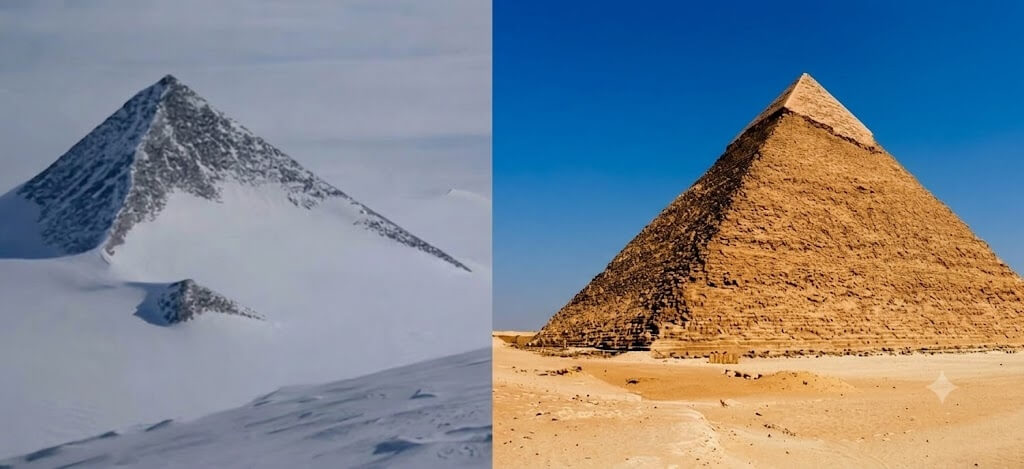
Would you believe that on the desolate red soil tens of millions of kilometers away from Earth, colossal structures that shouldn't even exist are standing in absolute silence? Their shapes bear a hauntingly precise resemblance to the Great Pyramid of Khufu on Earth's Giza Plateau.
Is this the grandest coincidence in the cosmos, or a staggering secret that space agencies have intentionally buried for half a century?
Our story begins fifty years ago, on July 25, 1976. On that day, NASA's Viking 1 orbiter was circling and photographing an area in the Martian northern hemisphere known as Cydonia, just as it had done a thousand times before. Suddenly, a digital image transmitted back to Earth struck the scientists in the control room into a dead, stunned silence.
While everyone is familiar with the world-famous "Face on Mars" from that batch, few paid attention to what was looming just a short distance away: a massive, five-sided geometric monument. Because its silhouette resembled an Egyptian pyramid so profoundly, the scientific community gave it a name—the "D&M Pyramid."
This monolith stands 1.6 kilometers high and spans more than 3 kilometers at its base. Bizarrely, its edges appear razor-straight, boasting sharp corners and a degree of perfect geometric symmetry. How could features that on Earth are exclusively characteristic of artificial architecture appear on a freezing, dead, desert planet?
If there were only a single pyramid on Mars, we could easily dismiss it as a freak prank of nature. Yet, over the subsequent decades, as a denser fleet of rovers and orbiters swarmed the red world, people discovered that these eerie geometric structures were multiplying across the planet.
Near the Martian south polar region, scientists captured satellite images of several three-sided pyramidal mounds arranged in an incredibly orderly, precise equilateral triangle.
Even more jaw-droppingly, in 2007, the Spirit rover snapped a picture of an almost flawless "miniature pyramid rock" nestled in the dust of Gusev Crater. It featured sheer, clean-cut facets, looking exactly like a scale-model prototype of some grand monument. Meanwhile, out on the plains of Elysium Planitia, clusters of cone-shaped hills sit scattered across the terrain; viewed from above, their alignment mirrors the celestial, star-mapped patterns of ancient Egyptian civilizations.
Could it be that four billion years ago, during the "Golden Age" when Mars still cradled vast oceans, a super-civilization with an obsession for megalithic architecture once thrived here?
Faced with an avalanche of public speculation, official authorities and mainstream science quickly put forward a standard rebuttal: "Don't let your imaginations run wild. This is merely the handiwork of Mother Nature—specifically, a geological feature known as a yardang."
The scientific explanation does sound reasonably grounded: Mars endures some of the most violent, planet-wide dust storms in the solar system, with wind speeds fast enough to stagger the mind. Over billions of years, powerful gales laced with abrasive sand grains act like a relentless chisel, carving away at the Martian basalt. It is entirely possible, they argue, for nature to shard off rock into geometric hills with sharp ridges.
They also chalk it up to "pareidolia"—a hardwired tendency of the human brain to seek out familiar patterns in vague, random shapes. When sunlight hits ordinary hills at a specific angle, the resulting shadows can easily trick the human mind into "auto-completing" a pyramid.
Yet, can the wild Martian winds truly act like a meticulous engineer, carving out flawless equilateral triangles and pristine 90-degree angles? This catch-all explanation, understandably, has failed to convince everyone.
As the "erosion theory" took hold, an even more unsettling paradox surfaced: if these pyramids are truly just ordinary boulders, why has the official response been so notoriously peculiar?
Many independent researchers point out that for the past 50 years, authorities seem to have thrown up an intentional "information black hole."
For instance, in the publicly released images from the early days, many photos involving these sensitive terrains underwent heavy pixel compression and color grading. The originally sharp edges were blurred into ambiguity, almost as if someone were deliberately erasing finer details.
More mysteriously still, several historical probes equipped with specialized high-resolution cameras—sent with the explicit intent to re-photograph the Cydonia region in detail—mysteriously malfunctioned or lost contact right as they approached Martian orbit. This has cast a heavy shadow of conspiracy over the Martian pyramids. Even over the last twenty years, as rover cameras have become blindingly sharp, the driving routes and high-definition imaging schedules of major space agencies have kept a conspicuously polite distance, masterfully bypassing the most fiercely contested pyramid zones.
Are they genuinely protecting the public from the reality-shattering psychological impact of an extraterrestrial civilization? Or are they hiding an even deeper, darker secret locked away beneath the Martian crust?
Keep exploring
When you want adjacent angles on Solar System, the theme hub rounds up sibling articles in the same editorial voice. The full archive helps you compare how topics evolve as new missions and surveys release data.