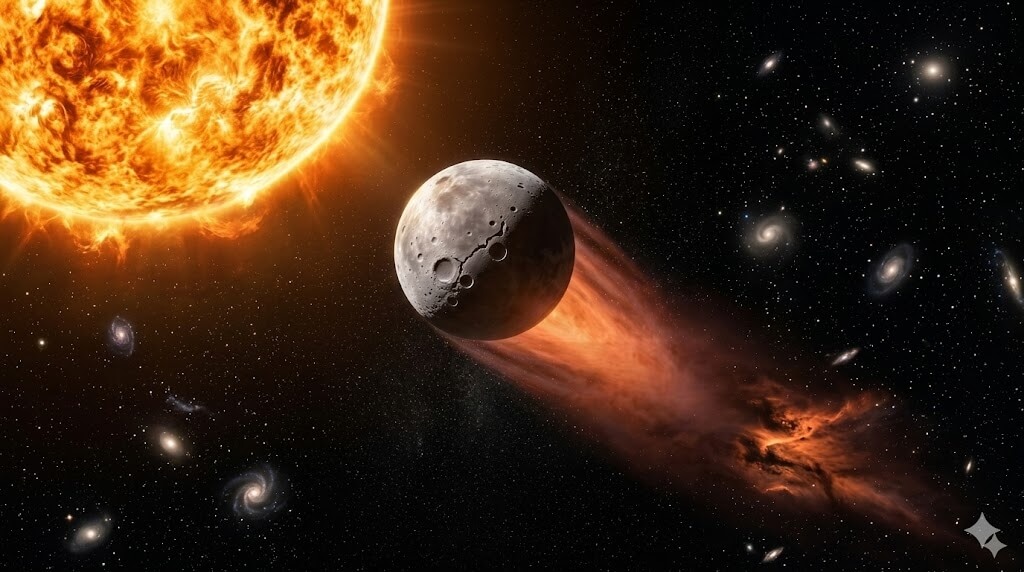
This is an epic tale of a planet caught in a desperate, lonely crusade on the absolute edge of devastation.
In mythology, Mercury is the fleet-footed messenger of the gods, sporting winged sandals as he streaks across the sky. But in the ruthless reality of the cosmos, he is a fugitive, running for his life on the razor's edge between a raging inferno and a bottomless abyss for 4.6 billion years.
If Mercury could speak, staring back at the sun that relentlessly closes in, threatening to swallow him whole at any moment, he would probably have just one thing to say:
"I've been running for 4.6 billion years. Please, can you just stop chasing me?!"
To stay alive, he has paid a horrific price. The four great mysteries etched into his body are the desperate survival cards he played, and the deep scars he bore, throughout this multi-billion-year cosmic escape.
Few people realize that, apart from comets, Mercury is the only planet in the solar system that travels with a "tail."
This is by no means a romantic decoration; it is a trail of blood and tears ripped from him as he flees. Positioned perilously close to the sun—averaging just about 58 million kilometers away—Mercury's surface is incessantly battered by ferocious solar winds and blistering radiation.
Mercury's feeble gravity stands no chance against this relentless assault. Sodium and potassium atoms are violently blasted off its surface by the solar wind. Pushed along by solar radiation pressure, these particles drag behind the planet, creating a pale-blue sodium tail that stretches for millions of kilometers.
As he hurtles through the void, the sun methodically peels away his outer layers. That long, trailing wake is living proof of a planet having its skin violently torn apart by solar storms.
One look at Mercury's internal structure reveals exactly why his flight is so filled with panic.
Getty Images
Mercury internal structure. Source: Getty Images
Terrestrial planets like Earth and Venus possess thick outer mantles and crusts, with their iron cores making up only a small fraction of their total volume. Mercury is completely different: its colossal iron core accounts for a staggering 85% of its entire volume!
Within the astronomical community, there is a brutal hypothesis regarding this "core mystery":
During the dawn of the solar system 4.6 billion years ago, Mercury was originally a much larger, massive planet. Early in his flight, however, he suffered a catastrophic gravitational encounter with the sun, or was violently pulverized by a barrage of other celestial bodies.
His thick, rocky outer coat—the mantle and crust—was entirely stripped away and vaporized, leaving behind nothing but a naked, heavy, metallic ball of iron. Mercury is not even a whole planet anymore; he is a cosmic skeleton, fleeing through the dark with his flesh and blood hacked away.
If you zoom in on Mercury's surface, you will find a face covered in jagged, terrifying scars. Beyond the dense fields of impact craters, the most peculiar features are the gargantuan cliffs that crest several kilometers high and snake across the globe for hundreds of kilometers.
In astronomy, these cliffs are known as wrinkle ridges.
They are the structural folds left behind by a planet undergoing rapid, violent cooling. Because Mercury's rocky mantle was stripped away, leaving mostly that massive iron core, the core began to cool and contract in the freezing temperatures of space over time.
As the core shrank, the outer crust could no longer fit around it. The entire planet began to violently collapse and crumple inward, much like a dehydrating apple. Mercury is pushing forward through this cold-and-heat purgatory by quite literally crushing his own body.
In this nightmare of being blasted point-blank by the sun, Mercury barrels along at a terrifying orbital speed of nearly 48 kilometers per second—1.6 times faster than Earth, making him the fastest speedster in the solar system. His daytime surface temperatures soar to a scorching 430°C, hot enough to melt lead.
Yet, on this hellish planet lies an unbelievable paradox: buried at his north and south poles are hundreds of billions of tons of pure water ice.
It sounds like a cosmic contradiction, but it is absolute fact. Because Mercury's rotational axis is almost perfectly perpendicular, the floors of certain deep craters at his poles have not seen a single ray of sunlight for 4.6 billion years. In these permanently shadowed regions, temperatures plunge to a frigid minus 170°C.
This ice was left behind by ancient comet impacts. Mercury has meticulously hoarded it, hiding it away in the darkest, coldest corners of his body. It is a stolen piece of solace from the freezing universe, fiercely protected by a fugitive staring down a raging wall of fire.
And so, Mercury has run for 4.6 billion years.
Braving a 430°C inferno, dragging a millions-of-kilometers-long tail, carrying a fractured body and a lifetime of scars, he executes a frantic, high-stakes dodge through the silent, airless void at the most extreme speed the solar system has ever seen. He dares not slow down for even a fraction of a second. If he does, the monstrous gravitational pull of the colossal master behind him will instantly tear this skeletal planet to shreds and swallow him whole.
Forty-eight kilometers per second, without a moment's pause. This tragic, lonely race against time will continue to play out across the cosmos for billions of years to come.
Keep exploring
When you want adjacent angles on Solar System, the theme hub rounds up sibling articles in the same editorial voice. The full archive helps you compare how topics evolve as new missions and surveys release data.