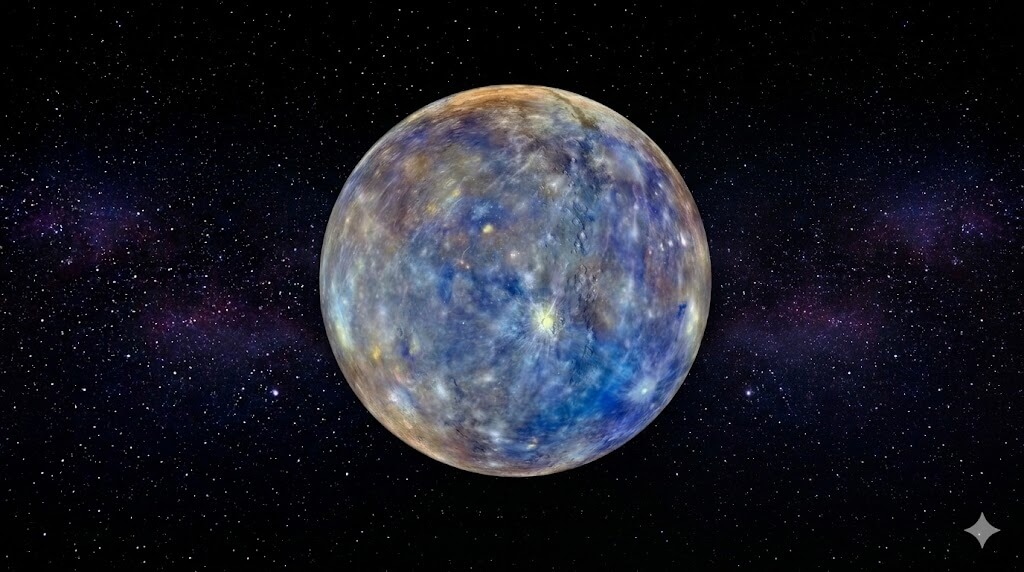
This is Mercury's very own "Song of Ice and Fire." Deep in the cosmos, a planet of sheer madness and contradictions hurtles through space. Trailing a massive, flowing "cape," it locks itself in a relentless race for survival against the sun's scorching fury.
As the innermost racer in the solar system's ultimate dead zone, Mercury braves hellish temperatures of 430°C, tearing around the sun at a blistering speed of nearly 50 kilometers per second. Standing on its surface would feel like witnessing the end of days. The sun looms suffocatingly large, its fierce solar winds acting like invisible whips, relentlessly lashing the planet. Under this brutal onslaught, Mercury is effectively being skinned alive—every single second, a staggering 1,000 kilograms of matter is ripped from its surface and blasted into the void of space.
Yet, this was only the beginning of how Mercury would shatter human expectations. When NASA's MESSENGER probe finally arrived after an arduous journey, scientists were struck with awe. This was no ordinary hunk of rock; the planet was trailing a colossal tail stretching 24 million kilometers into space! Long enough to wrap between the Earth and the Moon dozens of times, it made Mercury look from afar like a giant comet tearing through the cosmos.
The origin of this tail is equally mind-blowing. The material blasted off Mercury's surface by solar storms consists largely of sodium atoms from its crust. The moment these atoms break free, they are violently pushed back by radiation pressure—the literal push of the sun's photons. Thus, as Mercury races forward, it bleeds a vast trail of sodium into its wake, weaving a giant tail that glows with a faint, ghostly orange hue. It is the tragic spectacle of a celestial body being baked to vaporization under the sun's relentless glare.
If the story ended there, Mercury would simply be the solar system's ultimate underdog. But what NASA captured next at the planet's poles completely turned planetary science on its head. Amidst a living hell hot enough to melt lead, deep within its craters, Mercury is holding onto a staggering 20 to 60 billion tons of pristine water ice!
It sounds like an impossible paradox, but nature works in wondrous ways. Mercury's rotational axis is nearly perfectly upright, meaning it stands virtually straight up relative to its orbit. Because of this, the bottoms of many deep impact craters at its north and south poles have not seen a single ray of sunlight for billions of years. Inside these permanent shadow zones—abyssal depths of absolute darkness—temperatures remain permanently frozen below a bone-chilling -180°C. Water molecules delivered by ancient comet impacts became trapped in these deep-freeze sanctuaries, frozen instantly into sheets of ice and buried under layers of cosmic dust. Scalding on the outside, frozen to the core on the inside, Mercury pulls off the ultimate cosmic magic trick right under the sun's nose.
Staring at this bizarre world—with its comet-like tail, hidden ice reservoirs, and scorched crust—scientists couldn't help but wonder: how did it become so warped? When MESSENGER mapped the planet's interior, a cataclysm from 4.5 billion years ago was finally brought to light.
Typical rocky planets (like Earth) have iron cores that make up about 30% of their mass. Mercury, however, is a freak of nature: its iron core accounts for a staggering 70% to 80% of its entire body! It behaves less like a standard planet and more like a massive, naked ball of cosmic iron, wrapped in only the thinnest rind of rock.
This anomaly is the scar of a ruinous impact from the solar system's chaotic infancy. Originally, Mercury was a "normal" youth, roughly twice its current size. But then, a rogue protoplanet plummeted from the dark and struck it with apocalyptic force. The collision ripped the world apart, completely blasting away the lighter rock of its outer mantle and scattering it into the void forever. When the dust settled, only the dense, heavy, and ultra-high-melting-point iron core remained—the battered survivor of a cosmic hit-and-run.
This is the Mercury NASA uncovered: a heavy-metal remnant of an ancient, violent collision. It bleeds a magnificent, 24-million-kilometer tail as it races through a 430°C inferno, yet tenderly cradles tens of billions of tons of ancient ice in its darkest depths. Locked in an eternal embrace of fire and ice, it stands as the most isolated, tragic, and badass nomad of the solar system.
Keep exploring
When you want adjacent angles on Solar System, the theme hub rounds up sibling articles in the same editorial voice. The full archive helps you compare how topics evolve as new missions and surveys release data.