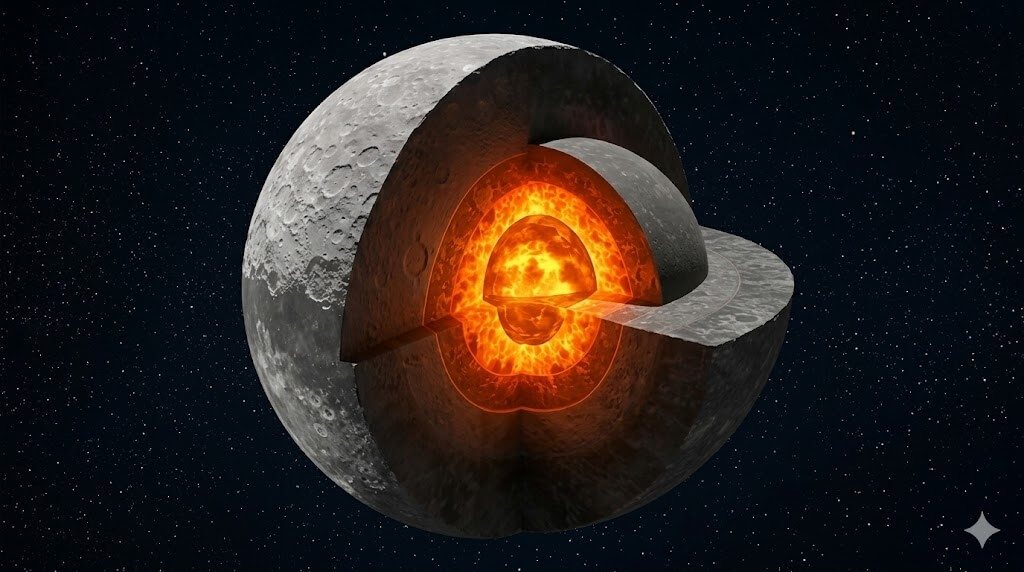
In this cosmic "Song of Ice and Fire," the madness does not stop at the surface. Beneath the razor-thin rocky crust, shattered by ancient, violent impacts, lies a "living heart" that continues to baffle scientists, and a majestic destiny hurtling toward its final curtain.
For the longest time, humanity assumed Mercury was nothing more than a dead, cosmic corpse. Given its diminutive size, it should have completely cooled down over the past 4.5 billion years, its interior freezing into a solid, lifeless lump of rock. And without the churning of liquid matter inside, a magnetic field should have been an absolute impossibility. Yet, when NASA's MESSENGER probe swept past Mercury, it detected something shocking: a weak but stubborn magnetic signal. This was definitive proof that a faint heartbeat still echoed inside Mercury's chest. Its colossal iron core had not frozen through; it was still keeping a liquid outer layer alive and churning.
How does a planet so small manage to keep its internal furnace lit while baked by the sun? When scientists meticulously analyzed MESSENGER's data, they found the secret locked within the core's recipe. Mixed into that giant iron core which spans a whopping 85% of the planet's radius—is an abundance of sulfur. Much like scattering salt on winter roads to keep water from freezing, this high concentration of sulfur acts as the universe's ultimate antifreeze, significantly lowering the melting point of iron. It is this cosmic cocktail that has allowed Mercury, even 4.5 billion years after its birth, to retain a scalding, fluid liquid core. Against the relentless barrage of solar storms, this core manages to power a magnetic shield that while fragile at just 1% of Earth's strength—is fiercely resilient.
However, this magnetic umbrella is deeply warped. Mercury's magnetic center doesn't align with its geographic core; instead, it is bizarrely offset toward the north pole by nearly 500 kilometers. As a result, Mercury's south pole is left almost entirely naked, mercilessly flayed by lethal solar winds, while the north pole manages to huddle under a sliver of protection.
Yet, even with "antifreeze" buying it time, Mercury's march toward cold and solidification is an inescapable destiny. As the eons tick away, the liquid core is slowly but surely turning to solid stone. And this internal freezing has triggered an utterly staggering consequence: Mercury is undergoing a multi-billion-year planetary shrinkage.
Over the past few billion years, as its interior cooled and withered, Mercury's diameter has shrunk by up to 14 kilometers! But while the inside is contracting, the rigid, long-frozen outer crust has nowhere to go. Under this crushing internal pressure, the planet's shell began to crack, buckle, and thrust upward, carving colossal scarps across the landscape that stretch for hundreds of kilometers and tower miles high. Seen from space, this proud planet now resembles a withered apple left out too long—its body entirely etched with the "wrinkles" of time and deep-space chill.
For this scarred, tightrope-walking planet, the final chapter is written in unavoidable, tragic destruction. In a few billion years, the energy deep within Mercury's core will completely run dry. That resilient, antifreeze core will freeze solid, and its magnetic shield will vanish forever. Stripped of its last defense, Mercury's surface will be systematically sandblasted away by the unmitigated fury of the solar wind.
But the true end will arrive in about 5 billion years. The sun, having burned through the hydrogen fuel at its core, will enter the twilight of its life and swell violently into an all-consuming Red Giant. The billowing surface of the dying star will surge outward like an apocalyptic tidal wave, and the first to be swallowed will be Mercury, the closest and longest-running companion to the star.
Deep within the sun's multi-thousand-degree atmosphere, Mercury's unyielding iron core, the very same core that survived the cataclysmic impacts of the early solar system, will instantly liquefy, vaporizing entirely into the solar fires from whence it came.
Mercury's life began with a devastating, primordial collision; it endured a long, brutally hardcore existence caught between a 430°C inferno and a -180°C abyss; and its end will be a return to dust, dissolving completely back into the mother star that breathed life into it in the first place.
Keep exploring
When you want adjacent angles on Solar System, the theme hub rounds up sibling articles in the same editorial voice. The full archive helps you compare how topics evolve as new missions and surveys release data.