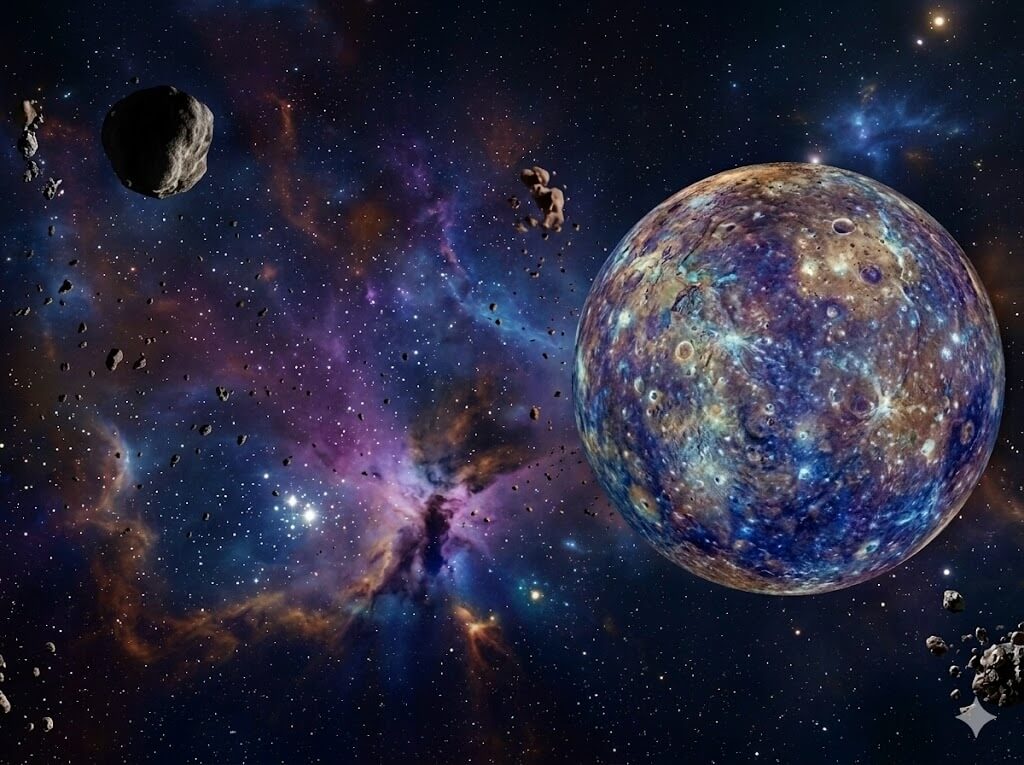
In the vast, endless expanse of the cosmos, there lies a mysterious planet closer to the Sun than any other. If we were to write its biography, the title would probably be Mercury: The Waterless Impostor Wrapped in Diamonds. Today, let's travel across the universe together and uncover the magical stories this planet has hidden for thousands of years.
Long, long ago, when ancient humans looked up at the night sky, they couldn't help but notice this little runner. It moved incredibly fast, slipping across the stars like an elusive ghost. In the West, the Romans thought it resembled Mercury, the fleet-footed messenger of the gods who wore winged sandals, and so they named this speedy planet after him.
Meanwhile, in ancient China, the great historian Sima Qian noticed a faint, grayish glow whenever he observed the planet. According to the ancient Chinese philosophy of the Five Elements (Metal, Wood, Water, Fire, and Earth), the colors black and gray correspond to "Water." With a stroke of his brush in the Records of the Grand Historian, Sima Qian officially named it the "Water Star" (Mercury). And just like that, the planet's greatest cosmic misunderstanding was born: it is called the Water Star, yet it doesn't have a single drop of liquid water. Instead, its surface is a scorched, barren wasteland baked by the Sun.
And yet, hidden atop this wasteland is a frosty secret buried deep within a fiery hell. As the planet closest to the Sun, Mercury's daily routine consists of enduring a relentless solar scorching, with daytime temperatures soaring up to 430°C—hot enough to melt lead. If a human were to stand there, they would be instantly incinerated. But miraculously, Mercury has a quirky trait: it sits perfectly upright, with an axial tilt of almost zero.
This creates a truly bizarre phenomenon. At Mercury's north and south poles, there are deep, yawning craters. Because the planet doesn't tilt, sunlight can never reach the bottom of these hollows. They have become the most isolated "permanently shadowed regions" in the solar system, where temperatures hover around a bone-chilling -170°C. Eons ago, comets and asteroids packed with moisture lost their way and slammed into Mercury's poles. The water molecules unleashed by the impacts stumbled into these pitch-black pits. Thus, a miracle occurred: on the most scorching planet in the solar system lies a massive "cosmic refrigerator," holding hundreds of millions of tons of ancient ice that haven't melted for billions of years.
If the polar ice is a miracle on Mercury's surface, an even more mind-blowing fortune lies buried deep within its core. This story takes us back to the dawn of the planet's creation, when Mercury was nothing but a rolling fireball of churning magma. Its interior was packed with carbon, making it resemble a boiling soup of graphite.
As the planet slowly cooled, Mercury's massive iron core began to solidify. This process unleashed unimaginable temperatures and terrifying pressures at the boundary where the core met the mantle. Like a pair of giant cosmic hands, these forces began to violently squeeze and crush the carbon atoms. The loose graphite finally yielded to the immense pressure, and its molecular structure shattered and reformed. Ultimately, it transformed into something dazzling—diamonds! Because diamonds are lighter than the iron core beneath them, they floated upward in droves, gathering deep beneath Mercury's crust to form a diamond cloak a staggering 15 kilometers thick. It is a subterranean world paved with countless carats of diamonds, holding a fortune far beyond humanity's wildest imaginations.
This is the story of Mercury: it bears the name of water but is engulfed in fire, yet it hoards glaciers in its hottest regions and conceals a coat of diamonds deep underground. Through billions of years of silent orbiting, it has proven one thing to the universe—a name is just a label, for true wonder always hides at the extremes of ice and fire.
Keep exploring
When you want adjacent angles on Solar System, the theme hub rounds up sibling articles in the same editorial voice. The full archive helps you compare how topics evolve as new missions and surveys release data.