In the infancy of our solar system, some 4.6 billion years ago, the newborn Earth was far from the azure, temperate cradle we know today; it was a raging volcanic inferno blanketed in molten lava. Back then, not a single drop of water could be found. Where, then, did the rolling expanses of today's Pacific and Atlantic Oceans come from?
It was a miracle woven from the convergence of three forces: a bounty from the cosmos, the violent metamorphosis of Earth itself, and a grand fusion that spanned millions of years.
Our story begins deep within the bowels of the planet.
Though the surface of the young Earth was a scorched, blackened wasteland, its incandescent belly harbored vast reserves of hydrogen and oxygen. Under the relentless crush of gravity and the furious radioactive decay brewing within, subterranean rocks melted away into massive, churning seas of magma.
As the planet's crust gradually cooled, water-bearing minerals trapped deep within the mantle underwent violent chemical transformations under unfathomable heat and pressure. They vaporized, turning into an inexhaustible supply of steam.
Finally, the pent-up fury of the deep breached its limits. Tens of thousands of volcanoes erupted simultaneously across the globe. Amidst rolling plumes of black ash and carbon dioxide, this subterranean steam was violently exhaled into the skies—much like the "sweat" of a runner during a grueling sprint. Held fast by the invisible leash of gravity, these vapors didn't escape into space; instead, they wove a thick, suffocating blanket around the planet: Earth's primordial atmosphere.
Yet, Earth's own "sweat" was far from enough to fill the vast oceanic basins that exist today. The planet needed reinforcements, and those reinforcements arrived from the freezing, pitch-black abyss of deep space.
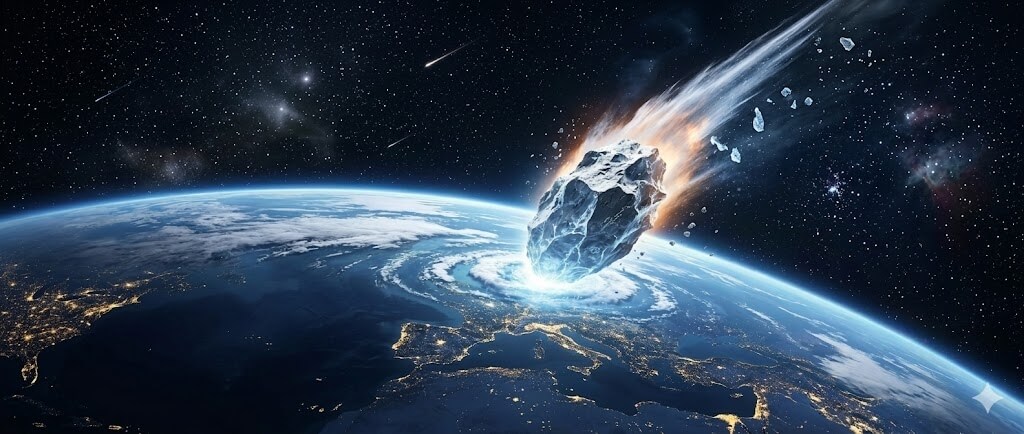
Around 4.1 billion years ago, the solar system entered a chaotic epoch known as the Late Heavy Bombardment. The asteroid belt, once stable, spun out of control. Countless small celestial bodies, as if driven by some cosmic command, turned into a relentless crossfire of meteors raining down on Earth.
It was a planetary delivery service that lasted for hundreds of millions of years. The primary "couriers" slamming into Earth were carbonaceous chondrites—seemingly unremarkable, charcoal-black space rocks originating from the outer fringes of the solar system. Locked securely within their porous matrices was an immense abundance of bound water.
Whenever one of these meteorites struck the planet at a devastating speed, the sheer force of the impact and the resulting inferno instantaneously vaporized the ice locked inside the rock. Like a tireless deliveryman, the cosmos used a succession of cataclysmic impacts to continuously pump water crystals—once frozen in interstellar space—straight into Earth's swelling atmosphere.
The stage was now set. The vapor from the planet's own sweat, combined with the water hauled in by the cosmic bombardment, choked the skies, enveloping Earth in an opaque, blinding canopy of dense water vapor.
Then came the moment of great fusion that would decide Earth's destiny.
As the solar system gradually settled into a quiet rhythm, Earth's surface temperatures finally began to drop, sliding below the critical threshold of 100°C. This cooling triggered a massive, domino-like chain reaction dictated by the laws of physics: the unimaginable volume of atmospheric steam began to condense into liquid droplets.
And then, the heavens opened.
A torrential downpour began—the longest, most unyielding deluge in the history of our world. This was a rain that didn't last for a night, or a single season, but fell relentlessly, on and off, for millions, perhaps tens of millions of years.
Sheets of endless rain pounded from the pitch-black skies onto the blistering terrain, forcing water droplets from completely different origins to melt into one. The torrents washed over the searing rock faces, leaching out their primeval salts, and rushed down the topography to pool into the titanic impact craters and gaping basins of the crust.
When the skies finally cleared and the multi-million-year deluge drew to a halt, a churning, vast, and breathtakingly blue primordial ocean had taken over the Earth.
The next time you lift a glass and take a sip of ordinary water, let it linger on your tongue for just a second.
Consider that roughly half of what you are drinking might have originated from a stray space rock that traveled millions of miles across the void before fracturing against our infant world 4.6 billion years ago. The other half was likely coughed up 4 billion years ago as a searing blast of steam from a hellish volcanic geyser.
They met in the skies, fused in the atmosphere, and settled into the seas—ultimately turning into the very lifeblood of our planet.
Keep exploring
When you want adjacent angles on Solar System, the theme hub rounds up sibling articles in the same editorial voice. The full archive helps you compare how topics evolve as new missions and surveys release data.