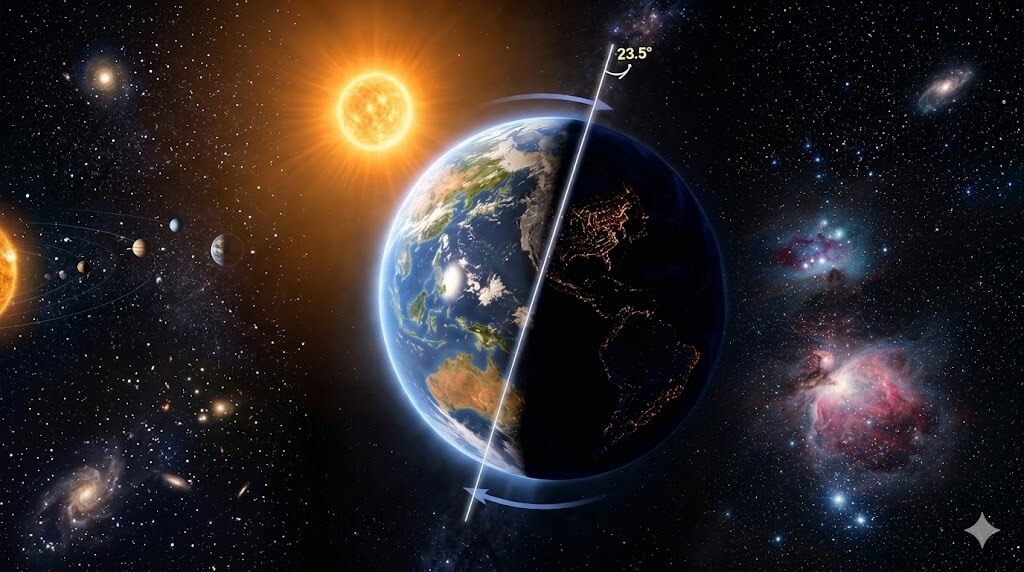
This is a grand cinematic masterpiece of light and shadow, co-starring the universe, the Sun, and the Earth. Its script, however, is hidden inside a long-standing misconception. For the longest time, humans have shared an intuitive belief: since the Sun is a giant ball of fire, we must be closer to it in the summer and farther away in the winter.
But the universe has played a massive joke on us. The true climax of this story actually unfolds around January 3rd every year.
On that day, the Northern Hemisphere is locked in the dead of winter. People are bundled up in heavy down jackets, shoulders hunched against the biting cold on streets where breath turns to frost. Yet, at that very moment, Earth is hurtling along at full throttle, reaching its closest stop to the Sun—perihelion.
Right now, Earth is "merely" 147 million kilometers away from the Sun. Compared to six months later, we are actually a staggering 5 million kilometers closer to this giant cosmic furnace!
So why are we freezing our tails off instead of sweltering in the heat? Because in the script of the universe, distance is never the main character. The true director is Earth's rather "unruly posture."
To understand this performance, we need to pull our camera back into the deep, empty expanse of space.
The Sun hangs silently at the center. Around it lies an invisible plain woven by gravity, known as the "ecliptic plane." Year after year, Earth loops around this plain. If it were any other well-behaved planet, its axis of rotation might stand perfectly upright, perpendicular to this surface.
But not our Earth. It behaves like a tipsy sailor, its body permanently tilted at roughly 23.5 degrees. What's even more stubborn is that no matter where it travels in its orbit around the Sun, this 23.5-degree tilt never changes direction, remaining locked onto the distant North Star.
It is this precise "head-tilt" that completely rewires the destiny of sunlight.
When our giant vessel, "Spaceship Earth," cruises to one side of its orbit, this 23.5-degree tilt causes the Northern Hemisphere to "puff out its chest" and lean directly toward the Sun.
At this point, sunlight strikes like a furious heavy punch, hitting the soil of the Northern Hemisphere dead-on in a fierce direct hit. A direct strike means highly concentrated light and explosive heat. Combined with daylight hours stretched to their absolute limits, this gives birth to the blazing, sun-drenched days of summer.
Paradoxically, at this exact moment, Earth is actually at its farthest point from the Sun—aphelion (around July 4th). That 5-million-kilometer gap doesn't mean a thing against the sheer, brute force of direct sunlight.Six months later, Earth takes its orbital cable car around to the opposite side of the Sun.The tilt hasn't changed, but because the position has, the Northern Hemisphere begins to "lean back," tilting away from the Sun. Now, sunlight can only glance off the curve of the Earth, striking at a tired, slanted angle. These slanted rays are stretched long and thin, their warmth drastically diluted, while the nights grow painfully long. And so, winter makes its icy debut in the Northern Hemisphere. And this occurs, as mentioned earlier, in January—the exact time we are closest to the Sun at perihelion.
Does this 5-million-kilometer shift in distance do absolutely nothing, then?No, it is a touch of tenderness left behind by the universe. Because the Northern Hemisphere happens to be a little closer to the Sun during its winter, a faint, subtle warmth is quietly injected into what would otherwise be a bone-chilling season, making it just a bit more bearable.
Ultimately, the birth of the seasons has nothing to do with Earth moving closer to or farther from the Sun. Instead, it is all about Earth, with its stubborn yet perfect 23.5-degree tilt, taking turns offering the Northern and Southern Hemispheres to receive the Sun's kiss during its year-long journey.
Every flower blooming in spring, every blanket of white snow in winter—it is all just our planet tilting its head as it spins through the cosmos, dancing a breathtakingly beautiful waltz.
Keep exploring
When you want adjacent angles on Solar System, the theme hub rounds up sibling articles in the same editorial voice. The full archive helps you compare how topics evolve as new missions and surveys release data.