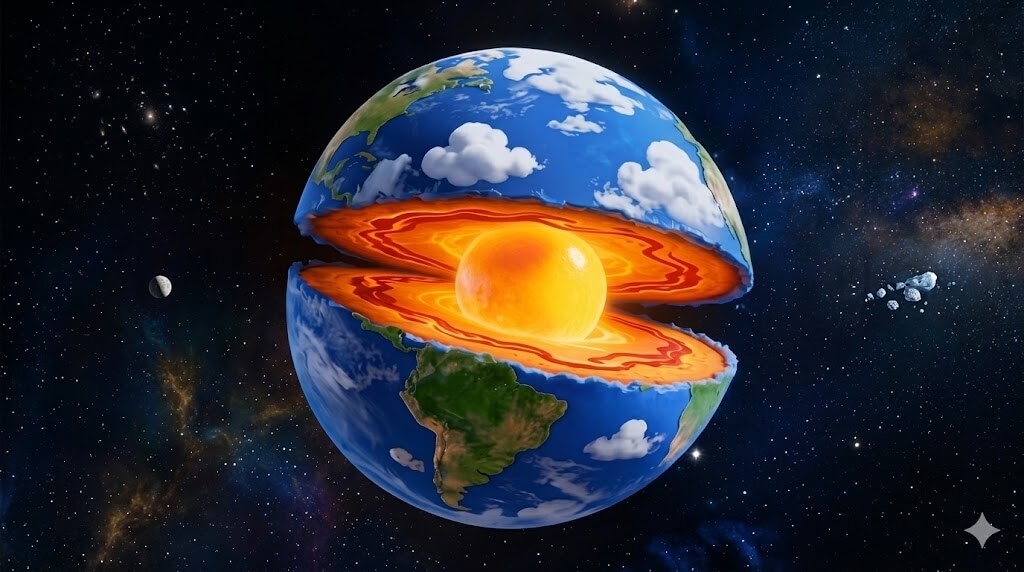
Once upon a time, about 4.6 billion years ago, to be exact, a cosmic swirl of ancient dust and rocks gathered in a grand carnival of gravity. They collided, fused, and ultimately gave birth to our planet Earth.
However, the newborn Earth was nothing like the gentle, beautiful blue planet we know today. It was a complete and utter "magma hell." The entire planet was ablaze, melted into a glowing, scalding soup of molten metal and rock.
During this chaotic period, a thrilling "grand reshuffling" took place deep within the planet (scientists call this planetary differentiation). Think of it like vigorously shaking a jar mixed with oil, water, and sand—once left to sit, they naturally separate into layers. In Earth's boiling soup, heavy materials began to sink, while lighter ones floated to the top. Eventually, Earth settled into the well-defined, multi-layered "layer cake" it is today.
Now, let's board an imaginary "Core Exploration Vessel" and travel from the outside in to witness the wonders left behind by this grand reshuffling...
Our exploration vessel first descends through the atmosphere and hovers at Earth's outermost layer. This is called the crust.
If Earth were a chicken egg, the crust would be its thin eggshell. Beneath the continents, it is about 30 to 40 kilometers thick, while under the ocean floors, it can be as thin as just 7 kilometers. While a few kilometers may seem unfathomably deep to us, if you scaled Earth down to the size of an apple, the crust would be thinner than the apple skin.
This layer is made entirely of solid, rigid rock. It is the cradle of humanity, majestic mountains, vast oceans, and all life as we know it.
Piercing through the crust, our vessel begins to shake violently. The temperature and pressure around us skyrocket instantly as we enter the mantle.
This is the "backbone" of Earth, accounting for over 80% of the planet's total volume. The mantle is composed mostly of heavy, dark rock. While the vast majority of it is solid, in a region near the crust known as the asthenosphere, the extreme heat and pressure turn the rock into something resembling heated toffee or hot asphalt.
Though incredibly thick and viscous, it is constantly and slowly flowing. This multi-million-year "deep-earth slow dance" (known as mantle convection) acts like a colossal conveyor belt, slowly carrying the tectonic plates of the crust above. Where they smash together, mountains rise; where they rip apart, magma spews forth. This slow dance is the ultimate puppet master behind earthquakes and volcanic eruptions.
Continuing our dive, at a depth of about 2,900 kilometers, the scenery shifts dramatically. We have arrived at the edge of the core.
First to greet us is the outer core. The temperature here exceeds a scorching 4,000°C. Rocks have no place here; instead, we are met by a vast, churning ocean of liquid iron and nickel.
This violent metal sea is absolutely vital to Earth. As the planet rotates, the sloshing, flowing liquid iron acts like a colossal dynamo, continuously generating the Earth's magnetic field. This invisible "shield" wraps around the planet, blocking deadly cosmic radiation and solar winds. Without it, Earth would have turned into a barren desert long ago.
Magnetic field that protected the Earth from solar wind.. Source: Getty Images
The Final Destination: The Inner Core — The Scorching, Solid "Iron Ball"
At long last, our exploration vessel reaches the absolute center of the Earth—the inner core.
The temperature here has reached a terrifying 6,000°C—just as hot as the surface of the Sun! By all rights, everything here should be melted into oblivion. Yet, miraculously, the inner core is a rock-hard, solid metal ball.
Why? Because the immense weight of the entire planet is pressing down on this very spot. Under this world-crushing, unimaginable pressure, the iron and nickel atoms are squeezed together so tightly that they cannot move at all. Thus, it exists as one of the most bizarre wonders of the universe: a metal ball that remains completely solid despite being heated to 6,000 degrees.
Our journey has come to an end. But to tell you a secret: humans have never actually been here. The deepest hole humanity has ever managed to dig is just over 12 kilometers deep (the Kola Superdeep Borehole)—we haven't even pierced the "apple skin" (the crust) yet.
So, how do scientists know all these stories? Whenever an earthquake strikes somewhere in the world, the resulting shockwaves act like a massive "ultrasound flashlight," illuminating the planet's interior. By listening closely to these "echoes" from deep underground, scientists have been able to piece together the wondrous tale of the world beneath our feet.
Keep exploring
Explore related guides on What's inside the Earth? from the category hub, or browse the full topic list for more articles in the same field.