It all began on a quiet night back in 2011. Scientists at NASA were glued to their screens, scanning the streams of data beamed back by the Kepler Space Telescope, just as they did every other night. Suddenly, a faint, flickering signal from 635 light-years away made everyone catch their breath.
Deep in the constellation Cygnus, there was a star almost identical to our Sun. And orbiting it was a planet, floating silently in the dark, glowing with a faint, ghostly blue light.
Thrilled, the scientists gave it a name: Kepler-22b.To astronomers, this newly discovered world was nothing short of a miracle.
It wasn't too big, nor was it too small; it sat perfectly inside what we call the "Goldilocks Zone"—the habitable zone of its star. Being neither too close nor too far from its sun meant the planet received just the right amount of heat. Scientists calculated that if Kepler-22b had an atmosphere similar to Earth's, its average surface temperature would hover right around 22°C (72°F).
That is the temperature of a flawless spring afternoon on Earth, where the breeze is gentle and warm. Even better, its orbit lasted 290 days. If you lived there, your birthday calendar wouldn't feel much different from the one we use on Earth.
Instantly, the world caught fire. Headlines across the globe blared: "Earth 2.0 Discovered!"
But if there is one thing the universe excels at, it is giving us hope, only to shatter it. As scientists used more advanced tools to get a closer look at this distant paradise, the romantic illusion began to unravel.
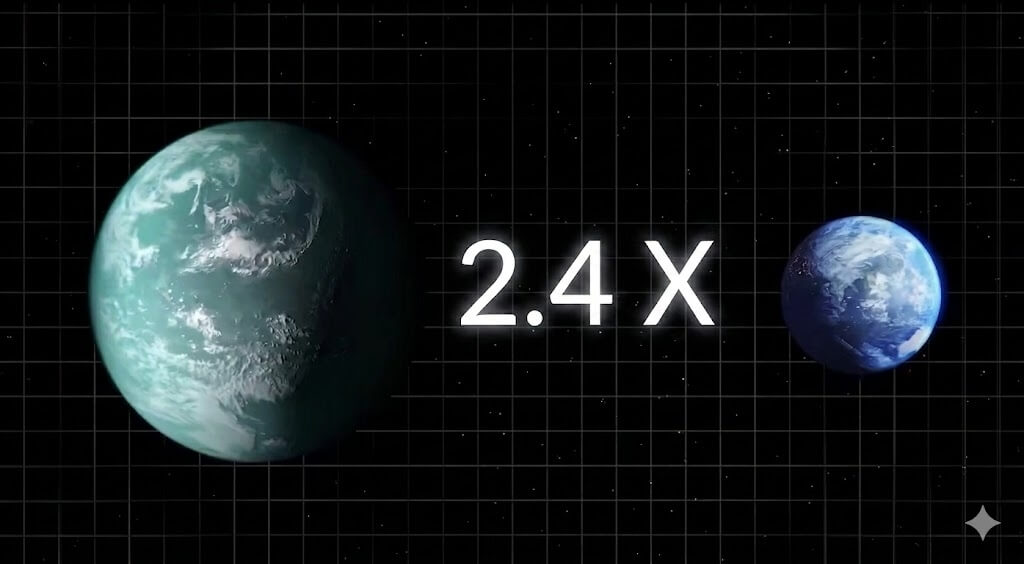
They discovered that Kepler-22b is about 2.4 times the size of Earth. In astronomical terms, this size puts it in an awkward middle ground—somewhere between Earth and Neptune.
It is highly likely that this planet looks nothing like the "parallel Earth" we imagined, with its rolling mountains, sprawling continents, and lush forests.
Instead, it is probably a "water world" with no dry land at all, smothered beneath an incredibly thick, heavy atmosphere. There would be nowhere to stand—just a violent, bottomless ocean. It might even just be a "puffy" gas planet with no solid surface whatsoever.
The "second home" we so eagerly claimed might not even have a single rock for us to step on.
But let's play devil's advocate. Even if Kepler-22b turned out to be a lush, beautiful paradise, could we actually get there?
This is where the story hits the brick wall of cold, hard reality. 635 light-years. On a cosmic map, that distance is less than a millimeter. To humanity, it is an eternal sigh.
Imagine if today, humanity pooled all its wealth and resources to build a starship at the absolute peak of our technological capability, packed it with our finest astronauts, and launched it into the dark.
The ship passes the Moon, the final frontier of the Apollo missions. But travelling at Apollo speeds, it would take 17 million years to reach its destination.
The ship tears out of the solar system and overtakes Voyager 1, currently screaming into interstellar space. At Voyager's speed, the trip would still take 11 million years.
Even if we use our absolute cutting-edge technology—the speed of the Parker Solar Probe, which uses the Sun's gravity to whip itself through space at a blistering 700,000 km/h—the journey would still take a staggering 1 million years.
What does 1 million years even mean? A million years ago, our early human ancestors had only just learned to walk upright and control fire.This means the astronauts on board would have to reproduce for countless generations. Over this vast stretch of time, they would forget what Earth even looked like. They would evolve into a completely new species. It is highly likely that before the ship even made it halfway, human civilization back on Earth would undergo a technological explosion, build a faster ship, and fly right past them. Or worse, Earth's civilization might long be extinct, leaving these travelers as the last drifting orphans of humanity.
And still, the finish line would be nowhere in sight.
It is as if the universe deliberately locked us down with a cosmic ball and chain called the "speed of light." It puts a price tag on a perfect planet, displays it beautifully in a shop window, lets it twinkle in the night sky, and then draws an insurmountable chasm between us.
Out there, Kepler-22b continues its silent orbit, bathed in its gentle 22°C breeze.
And down here, humanity continues to look up from Earth. We know we may never get there. But as long as that tiny pixel of light keeps blinking in the dark, humanity will never stop reaching into the deep. Perhaps that is the most brutal, yet most beautiful, ending this story could ever have.
Keep exploring
When you want adjacent angles on Solar System, the theme hub rounds up sibling articles in the same editorial voice. The full archive helps you compare how topics evolve as new missions and surveys release data.