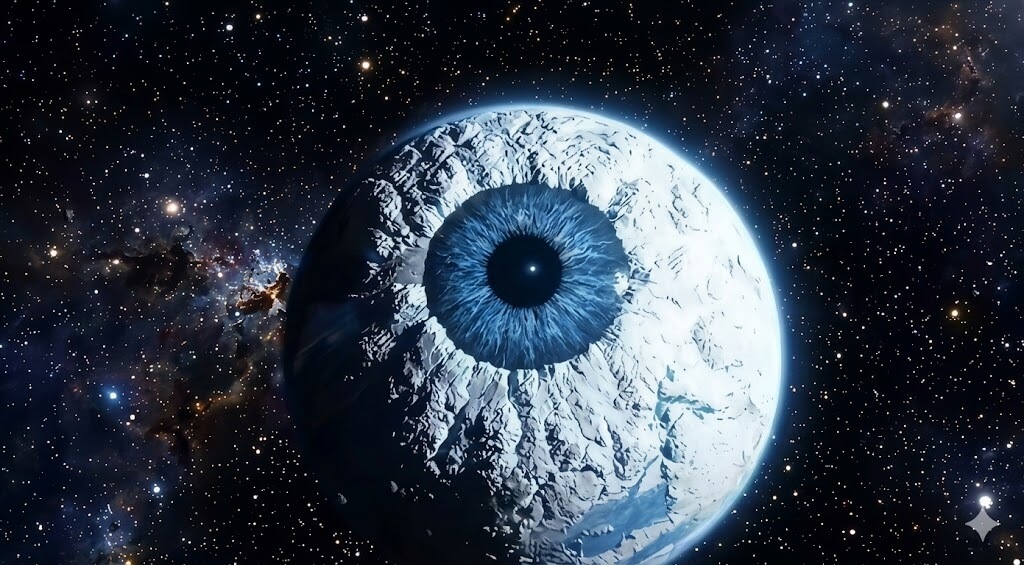
Forty-eight light-years away in Cetus, the super-Earth LHS 1140 b looks like a colossal eye fixed on the cosmos: glacial lids around a deep-blue pupil that never blinks.
This guide follows LHS 1140 b from tidal locking and its vast water budget to Webb-era atmospheric clues, climate circulation between eternal day and night, and what this world might teach us about life beyond Earth.
The Unblinking Eye in the Constellation Cetus
Deep in the constellation Cetus, LHS 1140 b orbits a small red dwarf about 48 light-years from Earth. From afar, the planet can resemble a motionless cosmic eye staring into the void.
This is not metaphor alone: a permanent dayside ocean set inside surrounding ice sheets forms a striking bullseye geometry in orbital imagery and simulations.
The object has become a focal point in discussions of ocean worlds because it challenges how we picture water-rich planets far from our own.
Captured by Gravity: A World Split in Two
LHS 1140 b orbits close enough to its star that gravitational locking has likely frozen its rotation relative to the host star, much like the Moon always shows one face to Earth.
On the nightside, temperatures plunge and ice dominates, producing a cold, dark hemisphere often described as a planetary snowball in space.
On the dayside, continuous stellar heating sustains a very different regime: persistent warmth, melting, and an open ocean under a sun that never sets.
The 4,000-Kilometer Bullseye Ocean
On the permanently illuminated face, stellar heat melts a broad circular ocean estimated at roughly 4,000 kilometers across, ringed by ice sheets.
From orbit, the contrast between white glacial margins and deep spectral blue water produces the iconic eye-like appearance.
Unlike Earth's rotating weather cycles, this ocean sits under fixed illumination, making its climate dynamics fundamentally alien.
A True Cosmic Reservoir Compared with Earth
Earth's oceans are immense by human standards, yet water is only a tiny fraction of our planet's total mass—on the order of hundredths of a percent.
LHS 1140 b appears far wetter by bulk composition, with estimates suggesting water could make up a substantial share of total planetary mass.
Beneath surface ice and open ocean, models allow deep interior oceans extending tens to hundreds of kilometers, potentially exceeding Earth's total water volume by large factors.
Atmosphere, Red Dwarfs, and Webb-Era Clues
Habitability depends on more than water. Atmosphere is the gatekeeper that can preserve oceans or lose them to space under harsh stellar conditions.
Early concerns focused on red-dwarf flares stripping atmospheres, but LHS 1140's host star has been relatively quiet in observations so far.
Recent James Webb Space Telescope spectroscopic work suggests the planet may not resemble a hydrogen-dominated mini-Neptune and could instead host a thicker, nitrogen-rich atmosphere more akin to Earth's style of climate shielding.
Winds, Chemistry, and a Primordial Crucible
If a substantial atmosphere exists, global winds and ocean currents may transport dayside heat toward the frozen nightside, reducing runaway evaporation or complete freeze-out.
At glacier-ocean boundaries, melting zones could mix elements and organic precursors in environments reminiscent of early Earth chemistry.
Under stable temperatures, liquid water, and atmospheric protection, life might not be confined to a hidden subglacial ocean but could exploit persistent twilight photosynthesis on the eternal dayside.
A Dialogue Across 48 Light-Years
This world is both distant laboratory and cosmic mirror: it shows that habitability may take forms very unlike Earth's rotating blue marble.
Even on a permanently day-night divided planet, life could remain possible if atmospheric threads hold and oceans stay liquid.
Today, from Earth, astronomers point our most capable telescopes back toward that deep unblinking blue, listening for faint chemical breath in an ancient alien sea.
Keep exploring
Explore related guides on A Planet 48 Light-Years Away Hides an Eternal, Unblinking Cosmic Gaze from the category hub, or browse the full topic list for more articles in the same field.