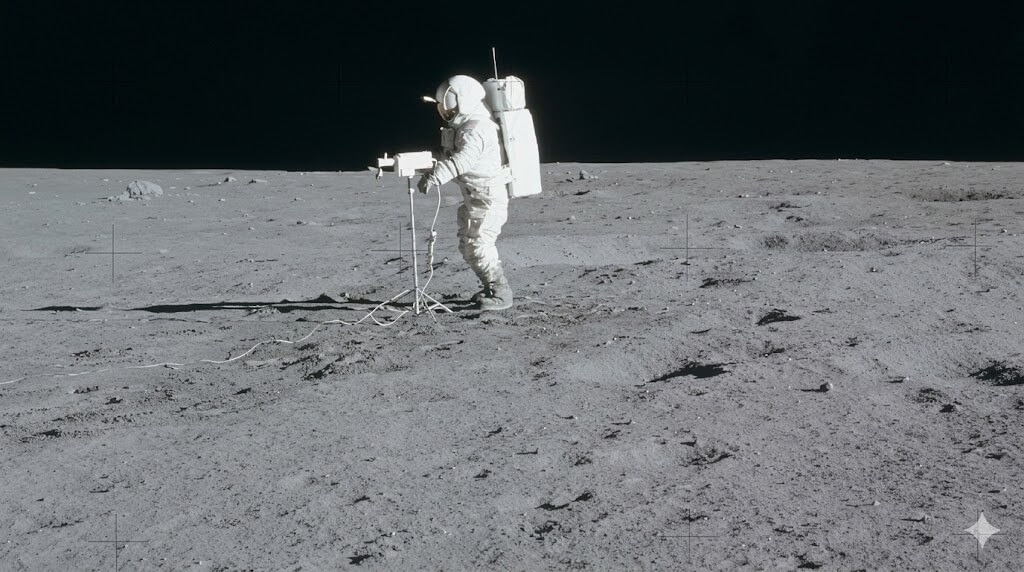
In the pitch-black deep space, some 380,000 kilometers away from Earth, lies a world ancient and desolate.
If you ever had the chance to touch down at the Sea of Tranquility base—stepping onto the very grounds where humanity first set foot in 1969—you would witness a breathtaking miracle. There, amidst a vast expanse of ash-gray wilderness, sits a pristine bootprint.
Its horizontal ridges remain sharp and defined, as if pressed into the soil a mere second ago. Yet, the man who left it, Neil Armstrong, departed this world more than half a century ago.
On Earth, howling winds scatter sandcastles, torrential rains wash away footprints in the mud, and time acts as an relentless eraser. But on the lunar stage, time itself seems to have hit a permanent pause button. There is not a breath of wind, not a drop of rain, not a falling leaf, nor even a single bacterium. That footprint remains captured like a time capsule frozen in absolute stillness, a lonely sentinel keeping watch over the eternity of the cosmos.
Yet, behind this romantic "eternity" lies no gentle fairy tale. Instead, it is a cosmic game of survival, cold and ruthless, played out over billions of years.
We humans are coddled by the tender embrace of Mother Earth—our thick atmosphere wraps around us like a warm duvet, shielding us from the fury of the universe. The Moon, however, stands stark naked, utterly exposed to the cosmic jungle.
Standing beside that very footprint, a mere turn of your head would plunge you into a true hell of fire and ice.
Under the direct glare of the sun, the surrounding rocks and soil are instantly baked to over 120°C (248°F)—a heat intense enough to scald.
Yet, the moment night falls (and a single lunar night drags on for about two Earth weeks), the temperature plummets off a cliff to a bone-chilling -180°C (-292°F). Facing a life-or-death temperature swing of over 300 degrees, any standard machinery from Earth would instantly snap; metals would grow as brittle as glass.
Even more terrifying are the "invisible bullets." With no atmosphere to act as a shield, lethal solar radiation and high-energy cosmic rays rain down in a relentless torrent. Out here, there is no sound; all destruction unfolds in absolute, terrifying silence.
But none of this is the most terrifying aspect of the Moon. What truly made the Apollo astronauts' skin crawl was the seemingly soft "dirt" beneath their boots.
On Earth, sand grains are tumbled and smoothed over millennia by rushing water and whistling winds. Lunar sand (regolith), however, is the debris of bedrock shattered by billions of years of meteorite impacts. Deprived of the weathering forces of wind and water, every single microscopic particle retains jagged, razor-sharp edges—acting like miniature shards of broken glass.
When the astronauts completed their moonwalks and removed their helmets inside the lunar module, they were horrified to find this "devil's sand" had infiltrated everywhere. Charged with static electricity, it clung stubbornly to their visors and spacesuits. As they inadvertently inhaled the dust, the cabin filled with a pungent odor resembling "burnt gunpowder," triggering severe coughing fits and hay-fever-like allergic reactions in everyone. These abrasive particles were even silently grinding away at the tough rubber layers of their spacesuits.
To make matters worse, the sky offers no warning before unleashing a "micrometeorite shower." Grains of rock no larger than sand specks hurtle toward the surface at cosmic speeds of dozens of kilometers per second. They are dense, invisible bullets capable of puncturing any defense in an instant.
Thus, that footprint, surviving half a century as crisp as the day it was made, is by no means a warm welcome from the Moon to mankind.
On the contrary, it is the coldest evidence the universe has to offer. It remains flawless precisely because it resides in a surreal hellscape—a place devoid of wind, water, and sound, yet overflowing with extreme temperatures, deadly radiation, and razor-sharp debris.
That footprint is a piece of immortal poetry, written in the territory of death by human technology and raw courage.
Keep exploring
When you want adjacent angles on Solar System, the theme hub rounds up sibling articles in the same editorial voice. The full archive helps you compare how topics evolve as new missions and surveys release data.