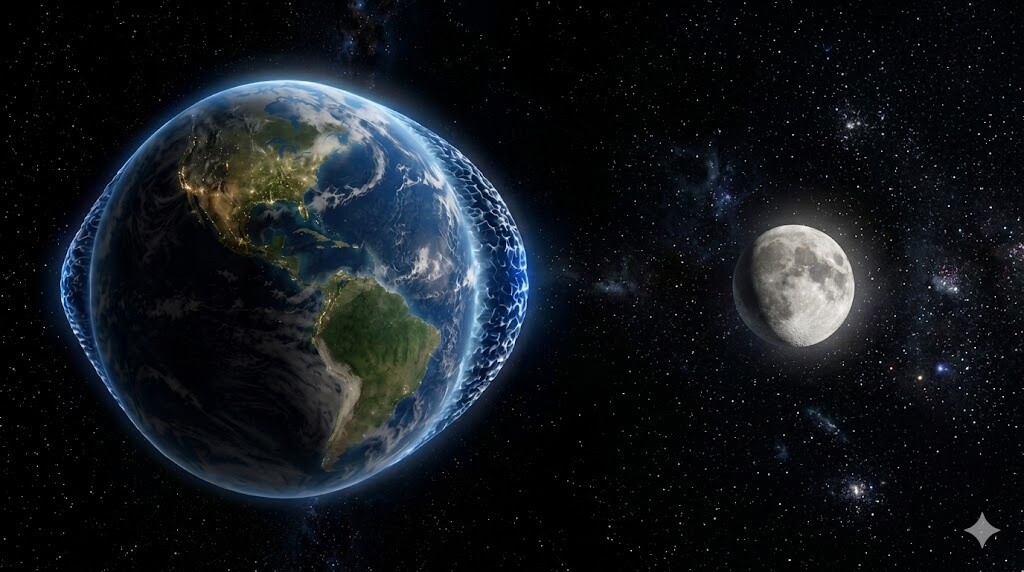
Imagine transforming our Earth into a giant water balloon. Not too far away, the Moon acts like a little magnet, relentlessly tugging at it day and night. Today, let's tell a story about how this cosmic trio—the Moon, the Sun, and the Earth—play a giant game of "tug-of-war" in space, weaving the grand tale of ocean tides.
Our story begins with the Moon, the ultimate "gravity magician."
Many people picture the Moon as a giant vacuum cleaner, sucking up the ocean wherever it goes. If that were true, we'd only get one high tide a day. In reality, the Moon plays a much subtler game called "differential gravity."
In this game, the Earth is split into three parts: the front side, the core, and the back side.
The Front Side (Facing the Moon): Being closest to the Moon, it feels the strongest gravitational pull. The ocean here gets aggressively "yanked" toward the Moon, bulging out away from the Earth's surface. This is what we call the "near-side tide."
The Earth's Core: Positioned right in the middle, it experiences an average amount of pull. Under this average tug, the Earth's solid core takes a collective step forward toward the Moon.
The Back Side (Facing Away): Being furthest from the Moon, it experiences the weakest gravitational pull. Now, here's the fun part—as the Earth's core shifts toward the Moon, the ocean on the back side feels so little pull that it "fails to keep up." From our perspective on Earth, the core essentially leaves the far-side ocean behind, creating another watery bulge in the opposite direction! This is the "far-side tide."
So, the Moon acts like a master noodle chef, stretching the Earth's oceans from both ends and turning our planet into a two-sided, oblong football.
Now, our cosmic stage features two stationary "water bulges" locked in place—one facing the Moon, and one facing directly away from it.
Meanwhile, we humans are passengers strapped into a rollercoaster called "Earth's Rotation." The Earth spins a full 360 degrees every 24 hours.
As you ride this planetary rollercoaster and spin along with the Earth, your day unfolds like this: Morning: You spin right into the water bulge facing the Moon. Voila! The water rushes in. That's your first high tide. Noon: You spin out of the bulge and into the valley between them. The water recedes—your first low tide. Evening: As you keep spinning, you hit the bulge on the back side of the Earth. Incredibly, the water rises again! That's your second high tide. Late Night: You dip back into the valley, and the water recedes once more—your second low tide. And that is exactly why coastal dwellers witness two high tides and two low tides every single day.
There is a slight catch, though: the Moon is also orbiting the Earth. By the time our rollercoaster finishes a full 24-hour lap, the Moon has quietly nudged forward. To catch up and realign with the Moon, the Earth has to "work overtime" and spin for an extra 50 minutes. Because of this, high tides are pushed back by about 50 minutes every day.
While the Moon is the star of the show, the Sun is the "behind-the-scenes boss" controlling the rhythm. Despite its staggering distance, the Sun is so colossally massive that its gravity also wrenches at Earth's oceans.
The Sun loves to step in at specific moments to shift the vibe: Around the New Moon (the 1st day of the lunar month) or the Full Moon (the 15th or 16th day), the Sun, Moon, and Earth align in a perfectly straight line.
At this moment, the gravitational forces of the Sun and Moon team up, pulling fiercely in the exact same direction. The oceans are stretched to their absolute limits, meaning high tides become exceptionally high, and low tides drop exceptionally low. This triggers the most spectacular event for beachgoers: the "Spring Tide."
However, around the First Quarter Moon (the 7th or 8th day) or the Third Quarter Moon (the 22nd or 23rd day), the Sun and Moon have a falling out. They stand at a right angle relative to the Earth—one pulling east, the other yanking north, actively sabotaging each other.
The Sun's gravity dampens the Moon's grip, flattening out the watery bulges. During this time, high tides aren't very high, and low tides aren't very low. This is the gentle, subdued "Neap Tide."
And that is how the oceans found their perfect, breathing rhythm.Whenever you stand on the shore and watch the waves sweep across the sand, remember that you are actually riding a massive cosmic rollercoaster, slicing through walls of water woven by the Moon's gravity—all while the Sun stands in the distance, silently conducting a symphony that has played for billions of years.
Keep exploring
Explore related guides on the Moon from the category hub, or browse the full topic list for more articles in the same field.