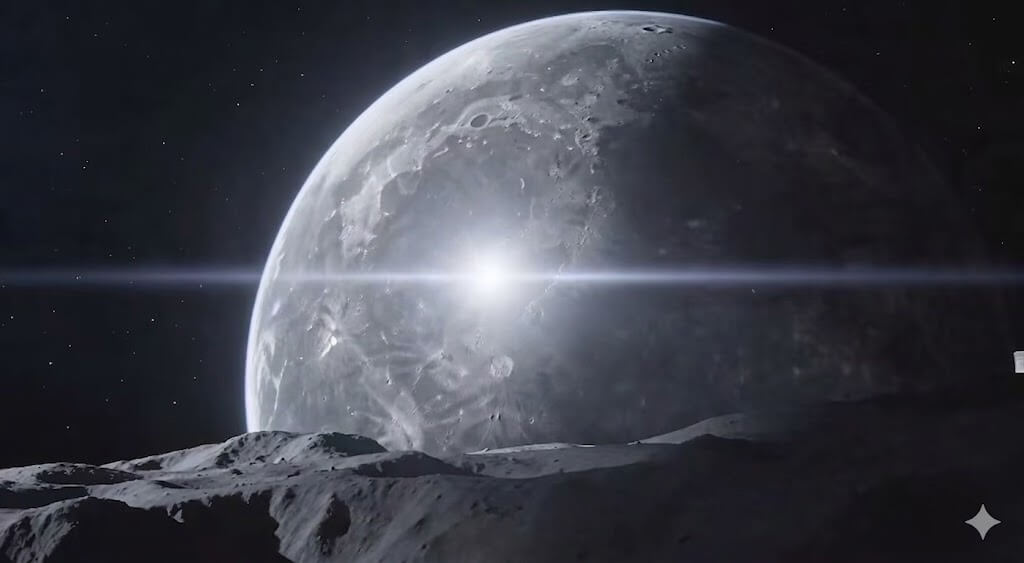
To most people, the Moon is nothing more than the cold, giant corpse of an ancient rock. Devoid of wind and water, it has slept in the pitch-black loneliness of deep space for billions of years.
Yet, for more than half a century, astronomers tweaking their telescopes back on Earth have occasionally stumbled upon scenes that defy explanation: amidst the deathly shadows of the lunar landscape, fleeting streaks of white light will suddenly flash into existence; at other times, an eerie crimson-purple aura will fringe the craters, or a hazy mist stretching for miles will rise out of nowhere, only to vanish into the void a few seconds later.
These mysterious gleams come and go without a trace, like ghost lights flickering across a desolate moor. In the scientific community, they bear a fascinating title: Transient Lunar Phenomena (TLP).
NASA's monitoring networks have cataloged thousands of these eyewitness accounts over a span of 60 years, but to this day, this "ghost" continues to play hide-and-seek with the world's top astronomers. Could it be that the Moon isn't entirely dead after all?
To unmask this cosmic culprit, scientists on Earth have launched a detective investigation spanning half a century. On their desks lie the case files, pinning down three primary suspects from the universe's "most wanted" list.
The first clue of our story lies in the Moon's virtually non-existent atmosphere.
Our Mother Earth is wrapped in a thick "air shield," where stray space rocks burn up into the shooting stars we wish upon long before they ever hit the dirt. The Moon, however, stands stark naked, utterly exposed to the cosmic jungle.
Imagine a quiet lunar night suddenly shattered as countless microscopic meteoroids, hurtling from the deep universe at terrifying speeds of dozens of kilometers per second, rain down mercilessly. With no air to slow them down, they smash directly into the lunar surface in a brutal, raw collision. Boom! In that split second of impact, an immense amount of kinetic energy is instantly converted into tearing, incandescent heat, unleashing a blinding, short-lived flash that pierces the darkness.
When the European Space Agency turned its automated telescopes toward the Moon, they discovered that these impacts happen nearly 8 times every single hour! They are an eternal, non-stop cosmic fireworks display, perfectly accounting for those blink-and-you'll-miss-it, one-to-two-second flashes.
However, our cosmic detectives soon hit a snag: if these flashes are just random meteoroid strikes, why do so many of the reddish mists and glows repeatedly burst from the exact same coordinates—most notably around the Aristarchus Crater?
This brings forward a second, far more enigmatic suspect: The Moon isn't fully dead; it is quietly exhaling.
Decades ago, astronauts from the Apollo missions buried seismometers into the lunar soil. Those instruments captured a subtle truth: deep within the Moon, a residual warmth remains, and the lunar crust still experiences occasional, faint tremors.
Whenever Earth's massive gravitational pull tugs and kneads the Moon like dough, fissures rip open across the lunar surface. At that exact moment, radioactive gases—like radon and argon—trapped deep in the planetary underworld, violently hiss out into the vacuum of space.
As these gas molecules erupt into the void, they crash head-on into intense solar radiation, or build up friction-induced static electricity from the violent venting. The result is a ghostly, glowing shroud of color hovering over the pitch-black craters. It isn't an alien outpost; it is the Moon heaving a quiet sigh from its very depths.
If the first two suspects didn't sound sci-fi enough, the third manifests as a pure, raw physical tempest—electrostatic discharge.
The Moon lacks a single breath of air, but its surface is constantly lashed by the solar wind—a violent stream of high-energy charged particles.
During the grueling lunar daytime, the sun-drenched soil builds up a massive surplus of positive electrostatic charges; meanwhile, the dark side plunged in shadow accumulates negative charges. When the Moon passes through specific regions of Earth's magnetotail, or when a massive solar storm erupts, the extreme voltage difference shatters the balance.
In a flash, immense electrostatic arcs snap between different regions of the lunar surface, or even ripple through the jagged, hovering clouds of lunar dust. It is exactly like the crackling blue sparks that snap when you pull off a sweater on a dry winter day—except on the sweeping, desolate plains of the Moon, this spark is magnified millions of times over, appearing in earthly telescopes as a mysterious, fleeting beacon of light.
If these three suspects seem so undeniably guilty, why do the world's leading astronomers still refuse to close the case, insisting that "a completely definitive explanation remains elusive"?
Because this "ghost" is exceptionally cunning. Every time it appears, it lingers for mere seconds or minutes. More often than not, just as a scientist gasps at their telescope, before they can hit the record button or calibrate a professional spectrometer, the Moon slips right back into its deathly, silent composure. To make matters more difficult, the vast majority of these thousands of historical records exist only as oral reports from amateur stargazers, severely lacking cold, hard, verifiable data from scientific instruments.
To this day, automated high-definition cameras from NASA and major observatories worldwide keep a 24-hour, unblinking vigil on the Moon, determined to catch its next fleeting "wink."
This 60-year-old manhunt has no ending yet. But those tiny glimmers flickering in the night sky serve as an eternal reminder to humanity: that gray world, which has accompanied us for 4.5 billion years, is no frozen corpse. Its skin, its veins, and its soul are very much alive, still violently resonating with the wild rhythms of the cosmos.
Keep exploring
When you want adjacent angles on Solar System, the theme hub rounds up sibling articles in the same editorial voice. The full archive helps you compare how topics evolve as new missions and surveys release data.