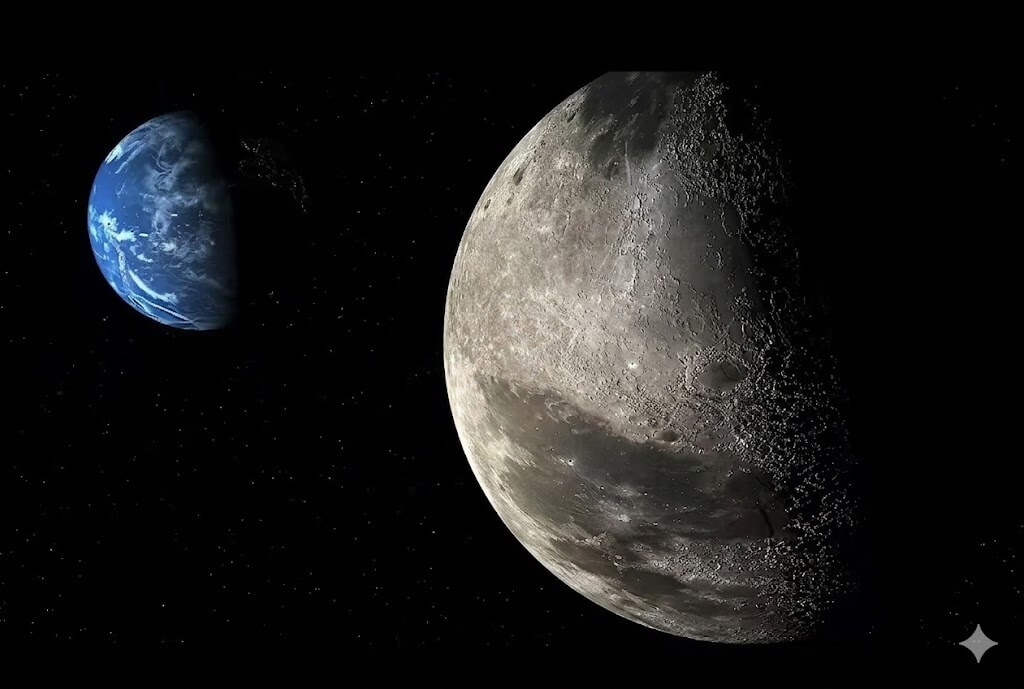
For millennia, humans have looked up at the Moon, always sensing that it was Earth's closest and most intimate companion. Yet, with the birth of modern astronomy, scientists placed the Moon under a metaphorical microscope, only to discover something startling: this cosmic best friend looks nothing like it came from the same womb as Earth.
Initially, acting like a committee of neighborhood busybodies, scientists put forward three classic "paternity hypotheses," but each was quickly and ruthlessly slapped down by reality:
The "Biological Daughter" Hypothesis (Fission Theory): Some scientists argued that during Earth's infancy, when it was still a spinning ball of molten lava, it rotated so rapidly that it hurled out a massive chunk of material from what is now the Pacific basin, forming the Moon. However, computer simulations eventually revealed that the primitive Earth could never have spun that frantically. Furthermore, the Pacific Ocean is vastly younger than the Moon, causing this "spin-dryer" theory to completely collapse.
The "Shotgun Wedding" Hypothesis (Capture Theory): Others suggested that the Moon was originally a rogue asteroid wandering through the cosmos until it passed too close to Earth, where it was snared by our planet's irresistible gravitational pull and forced to stay. But the Moon is simply too colossal—nearly a quarter of Earth's size. On the cosmic highway, if Earth's gravity had tried to slam on the brakes to capture an object that massive, it would have either pulverized the Moon entirely or sent it hurtling right past.
With the classic theories hitting a brick wall one by one, a shocking dark-horse hypothesis burst onto the scene during the Apollo missions of the 1960s and 70s—one that is still gleefully whispered about on the internet today: The Hollow Moon Hypothesis.
It began after 1969, when the astronauts of Apollo 12 and 13 completed their missions. To test the lunar crust, NASA intentionally crashed the spent ascent stages of the lunar modules back onto the Moon's surface to trigger artificial moonquakes. What the seismometers left behind recorded was bone-chilling: the Moon rang like a massive bronze gong, vibrating continuously for over three hours, its echoes refusing to die down.
Instantly, wild rumors spread like wildfire. Two Soviet scientists even went public with a theory: the Moon was no natural celestial body at all, but a hollow, titanium-alloy alien spaceship disguised as a planetary body, intentionally parked in Earth's orbit as a surveillance outpost!
As sci-fi-perfect as that story sounded, it was soon popped like a bubble by cold, hard science. Geologists later proved that the Moon's "gong effect" occurred because the lunar interior is profoundly dry, devoid of liquid water or loose moisture to dampen the vibrations. Its bedrock is as rigid as solid granite, meaning seismic waves bounce back and forth inside it like light reflecting in a room of mirrors. The Moon isn't a hollow spaceship; it's just a rock—unyielding, bone-dry, and solid to its core.
If it wasn't captured on the run, and it wasn't manufactured by extraterrestrials, then who actually gave birth to the Moon?
By the mid-1970s, combined the data from over 380 kilograms of lunar rock samples brought back by the Apollo missions to finally piece together the truth—a theory that remains the scientific mainstream and the most breathtaking answer we have: The Giant Impact Hypothesis (The Big Splash).
The story rewinds to 4.5 billion years ago. Back then, Earth was not the serene blue water-world we know today, but a raging, magma-covered youth—the Proto-Earth.
Out of the depths of space stepped an uninvited guest: a rogue planet named Theia, roughly the size of modern-day Mars.
These two hot-headed worlds collided in a cataclysmic, world-shattering cosmic fender bender. Theia struck the Proto-Earth at a wicked, glancing angle, delivering a savage blow right to its waist!
Instantly, Theia was pulverized into oblivion, while half of Earth's body was ripped away, blasted into outer space as a cloud of incandescent magma and debris.
This colossal explosion threw countless tons of molten rock, dust, and vaporized metal into orbit. Trapped by Earth's gravity, these scorching remnants formed a fiery ring of debris encircling the wounded planet. Over the next few thousand years—a mere blink of an eye on the cosmic timescale—the debris began to clump together under the pull of gravity, cooling and condensing.
Slowly, they kneaded themselves together to form the Moon we see today.
So, is the Moon truly Earth's biological child? The answer is: It is a hybrid child, born of Earth and another world.
According to isotopic analysis of the Apollo rock samples, the composition of the lunar surface is nearly identical to Earth's mantle. This proves that the Moon truly carries the bloodline of the Proto-Earth in its veins. That ancient cosmic crash from 4.5 billion years ago did not destroy our planet; instead, it forged the future of humanity:
The impact knocked Earth's rotational axis to a tilt of 23.5°, gifting our world with the rhythmic cycle of spring, summer, autumn, and winter, rescuing us from a stagnant, featureless climate.
The Moon's massive gravitational pull unleashed violent, early tides, acting as a giant cosmic blender that stirred organic molecules from the deep oceans onto the shores, directly jumpstarting the genesis of life.
When you look up at the Moon in the dead of night, you are not just looking at a cold, dead satellite. You are looking at a monument to a 4.5-billion-year-old survival story—a piece of Earth's own flesh joined with stardust, writing an immortal epic of life and guardianship.
Keep exploring
When you want adjacent angles on Solar System, the theme hub rounds up sibling articles in the same editorial voice. The full archive helps you compare how topics evolve as new missions and surveys release data.