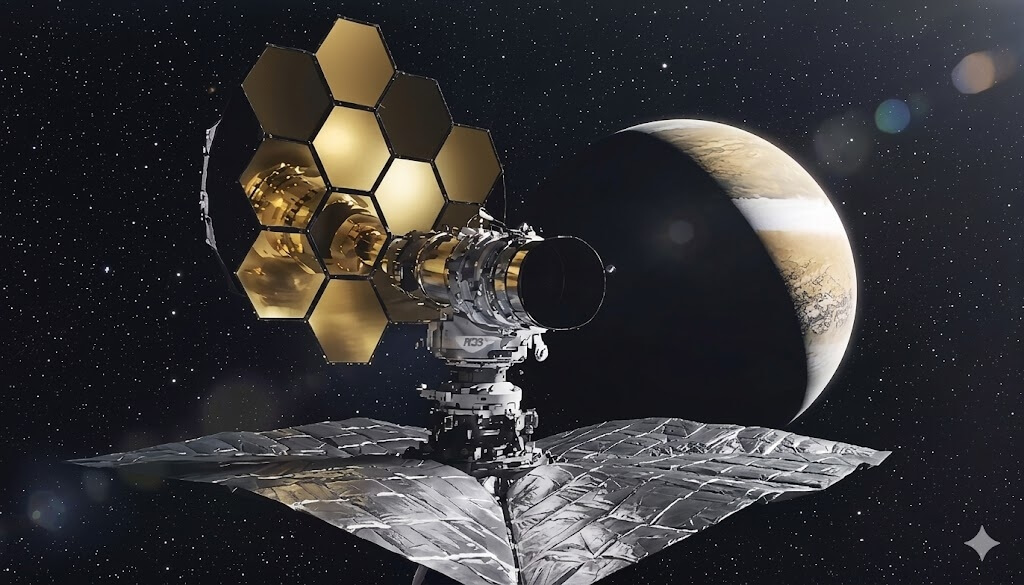
Following the dramatic and tragic final curtain call of Venera 13, humanity's surface exploration of this planetary purgatory fell into a forty-year dead silence. Those once-roaring metal hulls were thoroughly dissolved in the 460C furnace, weathering away into the very fabric of the Venusian landscape.
Yet, scientists back on Earth never truly gave up on it.
In the coming years, humanity will shatter this stillness, ushering in a golden age of "Returning to Venus." Major space agencies are already geared up and ready, planning to deploy more cutting-edge, modern technology to rip open the ultimate secrets that even concentrated sulfuric acid cannot conceal.
The curtain rises on this grand spectacle with NASA's "Discovery" program, marking their return after a thirty-year hiatus.
First to take the stage is a lone hero carrying on the legacy of Venera 13—DAVINCI+. It is, through and through, a "suicidal" atmospheric probe. Its design philosophy is profoundly tragic: like a meteorite, it will plunge headlong into the viscous, lethal atmosphere of Venus. During its grueling hour-long descent, like a starved traveler, it will frantically "inhale" the Venusian air, analyzing its chemical composition on the fly. Not only that, but it will snap photos furiously all the way down. In the final seconds before being crushed by the surface's extreme heat and pressure, it will beam back humanity's crispest, highest-definition images of Venus's ancient terrains, bringing its brief yet glorious life to a close.
Meanwhile, high up in the safe sanctuary of Venusian orbit, its sibling, VERITAS, plays the role of a detached, all-seeing eye. Refusing to put itself in harm's way, it will coldly gaze down at the inferno below using a powerful, next-generation synthetic aperture radar. The thick banks of sulfuric acid clouds, impenetrable to the naked eye, will be rendered virtually transparent under its radar sweep. Its goal is to chart a 3D topographic map of nearly the entire surface of Venus and definitively solve a mystery that has baffled humanity for half a century: are those menacing volcanoes down there still actively erupting?
At the same time, across the Atlantic, the European Space Agency (ESA) is refusing to be outdone, deploying its own versatile contender—EnVision. Acting like a meticulous physician, it will utilize infrared and ultraviolet spectrometers to catch even the faintest thermal fluctuations on the surface. What EnVision truly cares about is the closely guarded "heart" of Venus—is its internal core still pulsing with warmth like Earth's, or did it turn into a completely dead, frozen lump of iron eons ago?
If these probes are extensions of humanity, then the survival mechanism keeping them alive in purgatory is the "black technology" embedded deep within them.
The reason Venera 13 could only painfully endure for 127 minutes was that traditional terrestrial microelectronic chips were simply too delicate. Under the scorching 460 C heat, those silicon-based chips would be completely "cooked" and short-circuited within tens of minutes.
To shatter this irreversible fate, scientists in Earth's laboratories have forged a hell-hardened core using an entirely new material: Silicon Carbide (SiC) chips.
These chips seem practically engineered for the fiery seas of Venus. In an extreme furnace reaching up to 500C, they can continue their high-speed computations without breaking a sweat. This means future Venus landers can ditch their heavy, expensive, and largely futile cooling shells entirely. No longer destined to be short-lived "ghosts" surviving a mere two hours, they can transform into true "immortal ironclads," enduring on this hellish planet for days, weeks, or even months. They will be able to stroll leisurely across the Venusian surface, steadily operating their drills until they have excavated the planet's secrets completely bare.
Venus and Earth are strikingly similar in size and mass—they are essentially the closest twin brothers in the Solar System. Yet today, one has become a cradle for life, while the other has become the ultimate destination of destruction.
Humanity is returning to Venus at all costs, not just to inherit the unfulfilled legacy of Venera 13, but to look into the historical mirror of Venus and see Earth's own future clearly—will the ultimate end-game of the greenhouse effect become Earth's tomorrow?
The next generation of spacecraft, currently being assembled in workshops across Earth, quietly awaits the countdown. They are about to embark, surging once more toward that boundless horizon of acid rain and open fire.
Keep exploring
When you want adjacent angles on Solar System, the theme hub rounds up sibling articles in the same editorial voice. The full archive helps you compare how topics evolve as new missions and surveys release data.