On the vast, shadowy stage of the cosmos, there once lived a pair of "twins" that held the entire solar system spellbound. This was some four billion years ago. Had you been piloting a starship through the neighborhood back then, you would have seen two blue planets nestled side-by-side within the habitable zone. They were near-identical twins—matching in size, weighing virtually the same, and sharing the same molten rock coursing through their veins.
One was our Earth. The other was Venus.
In those days, Venus was a far cry from the nightmare it is today. In the supercomputer simulations crafted by NASA scientists, the ancient Venus was a true embodiment of its namesake—the goddess of love and beauty. It boasted shimmering, shallow oceans beneath a mild, azure sky. Carbon dioxide was kept safely locked away in the rocks and deep underground, keeping atmospheric temperatures pleasantly comfortable. Deep within those warm, primordial waves, the very first sparks of microscopic life were already beginning to stir.
Back then, they were true brothers, sharing the serene morning of the solar system. Yet, the turning point of their destiny arrived unheralded, set in motion by two fatal vulnerabilities.
The first was Venus's eccentric, "retrograde" rotation. In the solar system family, while all the other siblings sprint forward in a counterclockwise race, Venus moves like a lonely contrarian, spinning backward in a clockwise direction. Not only that, its spin is agonizingly slow—a single day on Venus outlasts 243 days on Earth. This means a Venusian "day" is actually longer than its "year."
Scientists suspect that eons ago, a rogue celestial giant struck Venus at a brutally precise, devastating angle. This cataclysmic impact didn't just slam Venus's rotation into reverse; it slammed on the brakes, trapping the planet in a grueling, perpetual crawl. Later, its absurdly thick atmosphere, dragged by the sun's gravitational tides, generated a ferocious friction that slowed its pace even further.
It was this quirk of a sluggish spin, combined with its closer proximity to the sun, that sealed its doom.
As the young sun aged, its furnace grew hotter. Being closer to the flame, Venus was the first to feel the heat, triggering the fateful first step of its undoing: the oceans began to boil. Vast expanses of seawater evaporated into the sky. In a cruel twist of irony, water vapor is itself a potent greenhouse gas; it blanketed the planet like a silken shroud, trapping the heat below.
As temperatures climbed, a demon seemed to awaken within the planet's core. A global barrage of super-volcanoes erupted in unison, unleashed floods of scalding magma across the landscape. The searing heat acted like a kiln, "baking" out the carbon dioxide that had long been safely locked away in the crust and rocks.
With no oceans left to soothe the planet, and lacking the tectonic plates that help Earth recycle carbon, this resurrected carbon dioxide had nowhere to go. It piled up in the sky, layer upon suffocating layer, weaving a massive, inescapable greenhouse blanket.
The beautiful, light-blue oceans vanished entirely, replaced by a dense, choking canopy of dark clouds made of 96.5% carbon dioxide. With that, Venus was permanently transformed into the solar system's ultimate purgatory.
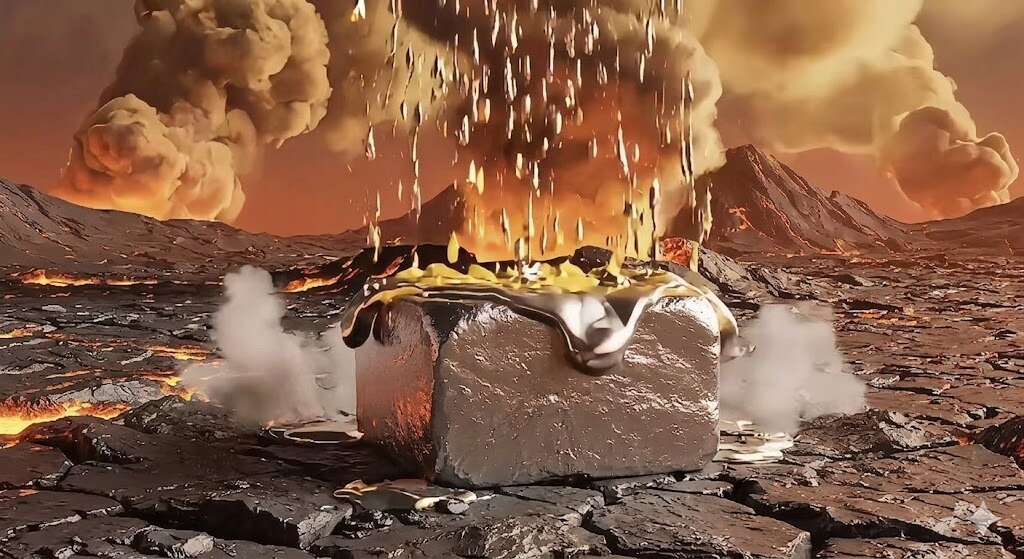
Today, temperatures there hover around 460°C—hotter even than Mercury, which sits closest to the sun—and hot enough to melt lead right on the ground. The atmospheric pressure is as crushing as the deep ocean, matching the terrifying weight found 900 meters beneath Earth's waves, enough to flatten a military tank in an instant. And the torrential rains that fall from its skies are no longer life-giving waters, but a corrosive downpour of pure, concentrated sulfuric acid.
From a sapphire paradise of oceans to a pitch-black hellscape of sulfuric acid, Venus used its own ruin to leave a haunting, cautionary silhouette for its twin, Earth.
Hanging silently in the night sky, shining as the brightest beacon in our solar system, it serves as a silent warning to humanity: once the greenhouse effect crosses that point of no return, heaven and hell are but a breath apart.
Keep exploring
When you want adjacent angles on Solar System, the theme hub rounds up sibling articles in the same editorial voice. The full archive helps you compare how topics evolve as new missions and surveys release data.