In the Solar System, there lies a planet perpetually shrouded in thick, heavy clouds—Venus. From a distance, it appears breathtakingly beautiful, radiant as a brilliant jewel. Yet, only those who have dared to venture close know that beneath that veil lies an absolute purgatory.
On March 1, 1982, a spacecraft from Earth shattered the silence of Venus. This was the Venera 13 probe, launched by the Soviet Union.
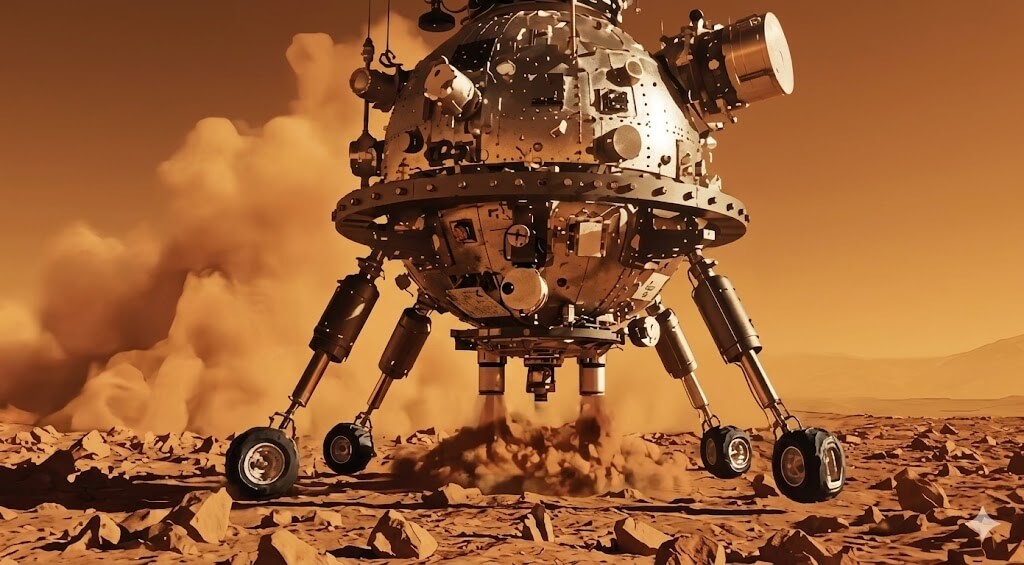
To uncover the truth of this misty planet, scientists back on Earth had armed it to the teeth. Stripped of any delicate wings, it resembled a heavy, cumbersome deep-sea diving bell, encasement-wrapped in an ultra-thick titanium alloy heavy armor. The scientists knew all too well that what awaited it was a literal journey of self-destruction.
Without a trace of hesitation, Venera 13 plunged headlong into the dense, multi-kilometer-thick banks of Venetian clouds.
The moment it entered the cloud deck, alarms began to blare. The clouds here were not born of water vapor, but of lethal concentrated sulfuric acid. In an instant, a highly corrosive acid rain poured relentlessly over the probe's titanium shell, unleashing a spine-chilling hiss of chemical corrosion.
Then, an even more bizarre spectacle unfolded. As the probe continued its descent, the surrounding temperature began to skyrocket. Miles above the ground, the fiercely corrosive droplets of sulfuric acid were instantly vaporized by the searing heat, turning into billowing plumes of toxic mist that surged back upward. It was a rain that would never touch the ground, yet it served as the first deadly barrier against any interloper.
Breaking through the toxic mist, Venera 13 finally caught sight of the Venetian surface. But the air here was thick, almost like a viscous fluid. Composed predominantly of carbon dioxide, the atmospheric pressure was a staggering 92 times that of Earth.
What does 92 times mean? It is equivalent to the crushing hydrostatic pressure found nearly 3,000 feet deep in Earth's oceans. If a human were to stand barefoot here, they would be instantaneously flattened by invisible, monolithic hands pressing in from all directions.
Venera 13's heavy armor groaned under the immense strain, but it held. Like a massive boulder, it slammed hard onto the desolate Venetian soil.
Upon touchdown, it was greeted by a surface temperature soaring at 460°C—heat intense enough to melt solid lead.
Scientists had anticipated that this metal-clad brute would survive no more than 32 minutes in such a furnace and crushing pressure. This was a one-way ticket with no hope of return; from the very fraction of a second it landed, its life was on a countdown.
Yet, Venera 13 displayed a staggering resilience. Amidst the violently scorching air, it raced against time to begin its work:
A Historic Shutter Click: Defying the surrounding inferno, it painstakingly rotated its camera lens and snapped the shutter. A priceless color photograph was converted into radio waves, piercing through the dense toxic clouds and racing across millions of miles back to Earth. For the first time, humanity laid eyes on the true face of Venus: a barren, orange-yellow landscape of rocks distorted by the intense heat.
The Final Drillings: Locking its mechanical arms firmly against the searing terrain, the probe extended its drill, biting deep into the scorched Venetian soil to perform an on-site analysis. It continuously beamed the data back to Earth, desperate to beat the impending meltdown of its circuitry.
127 minutes. It endured for over two hours in the heart of purgatory, setting a legendary record for spacecraft survival on the surface of Venus. Ultimately, its internal components were thoroughly baked through. Its signals degraded into a long, meaningless string of static before slipping into an eternal silence.
Today, more than 40 years have slipped by. Venera 13 still rests in that 460°C amber world. Under the relentless, decades-long assault of acid gas, crushing pressure, and extreme heat, its titanium armor has likely dissolved and corroded away, fusing completely into the blackened rocks of Venus.
With its own skeletal remains, it has erected an everlasting monument of human ingenuity upon this hellish planet.
Keep exploring
When you want adjacent angles on Solar System, the theme hub rounds up sibling articles in the same editorial voice. The full archive helps you compare how topics evolve as new missions and surveys release data.