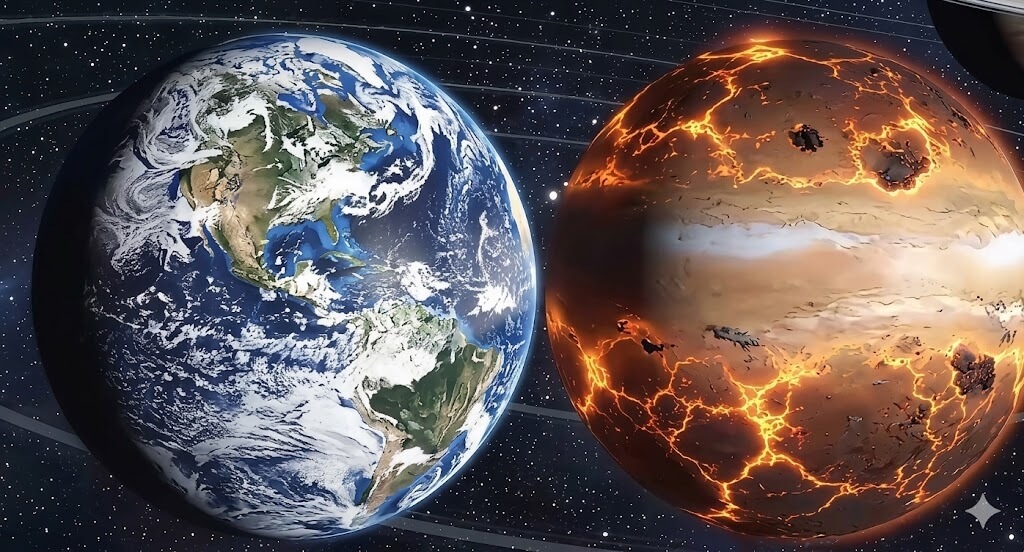
Four and a half billion years ago, within the swirling depths of a primordial nebula, Earth and Venus were born in almost the exact same region of space, at the exact same moment in time.
Boasting nearly identical mass, volume, and density—and sharing a virtually indistinguishable rock composition—they were spitting images of each other. Had an alien civilization gazed upon our solar system from afar back then, they would have undoubtedly marveled at what appeared to be a perfect pair of cosmic twins.
Yet, through the crucible of 4.6 billion years, these twin brothers diverged into polar extremes: Earth became a thriving cradle for life, while Venus degenerated into a cataclysmic purgatory.
But regardless of whether life exists on Venus today, it remains the ultimate mirror for Earth.
A Mirror into Earth's Past
Venturing back billions of years into the deep recesses of cosmic history, Venus was likely nowhere near the monstrosity it is today. Advanced computer simulations suggest that an early Venus may well have possessed a flowing atmosphere, a temperate climate, and even vast liquid oceans. In fact, back then, Venus might have offered a hospitable breeding ground for the seeds of life even earlier than Earth did.
By deciphering the geological architecture and rock signatures of Venus, scientists are essentially hunting for the ghost of an infant Earth. Venus stands as a corpse frozen in time, preserving the raw, violent upheavals of a planet's earliest formative years.
A Chilling Mirror of Earth's Future
This is where the Venusian mirror becomes truly bone-chilling. Today's Venus serves as the definitive apocalyptic template for a runaway greenhouse effect.
Over its 4.6-billion-year evolution, Venus's slightly closer proximity to the Sun caused its temperatures to edge upward, triggering the evaporation of its oceans. Because water vapor is itself a potent greenhouse gas, its accumulation sparked a vicious, catastrophic cycle: Rising Temperatures→Oceanic Evaporation→Accelerated Greenhouse Effect
As the oceans boiled away into oblivion, the carbon dioxide once securely locked within the seas and crust was unleashed entirely into the atmosphere.
Ultimately, atmospheric carbon dioxide levels skyrocketed to a suffocating 96.5%, weaving an inescapable thermal death trap.
Today, a surface temperature of 480°C and a crushing atmospheric pressure 92 times that of Earth are not the stuff of science fiction, they are a stark, planetary reality.
Staring into this mirror delivers a sobering wake-up call to humanity: Earth's biosphere is by no means indestructible. If we recklessly disrupt our atmospheric equilibrium and tip the first domino of greenhouse warming past a critical point of no return, Earth could easily trigger the exact same feedback loop, spiraling into the very same bottomless abyss.
Shattering Geocentrism: Redefining Life's Boundaries
In recent years, scientists detected trace amounts of phosphine gas floating high within the thick, sulfuric acid deck of Venus. On Earth, this specific gas is intimately linked to the metabolic activities of anaerobic microbes.
This discovery ignited a wildfire of scientific imagination: could some form of extremophile life be tenaciously thriving amidst the acid rain, fifty kilometers above the hellish surface, where temperatures and pressures mirror those of Earth?
This particular mirror shatters humanity's arrogant, Earth-centric view of biology:
If life does exist on Venus (even as mere microbes), it will prove that life in the universe is overwhelmingly resilient—capable of growing wildly given even the narrowest sliver of an opening.
If Venus is completely barren, it serves as an equally profound mirror. It illustrates just how exquisite the luck, and how flawless the balance, must be to spark and sustain an ecosystem capable of nurturing a civilization.
They set out side-by-side 4.6 billion years ago, only to meet vastly different destinies. Venus hangs in the cosmic void like a colossal, silent alarm. Humanity's relentless drive to hurl probes into its acid rains and ocean of fire to spy out its secrets is fueled by more than just stellar curiosity. It is a desperate quest to find, within this 4.6-billion-year-old mirror, the ultimate keys to safeguarding our own home planet.
Keep exploring
When you want adjacent angles on Solar System, the theme hub rounds up sibling articles in the same editorial voice. The full archive helps you compare how topics evolve as new missions and surveys release data.